Success Stories

Mining, Metals and Minerals

Exxaro GMEP

Read the success story below

Doubling the world’s largest coal beneficiation complex

Goals

  • Increase throughput from 8,750 to 14,600 tonnes per hour
  • Supply the Medupi power station with an average of 14,6Mtpa
  • Introduce high levels of operational safety
  • Employ the latest technology in coal beneficiation and plant automation
  • Provide flexibility in the coal beneficiation capacity

Solutions and Products

  • AVEVA System Platform
  • InTouch
  • Historian
  • MES Performance

Challenges

  • Working with several different third-party suppliers and integrating their solutions into the system
  • The systematic hot-commissioning cut-over to full production, per section, while production was in full operation on previously-commissioned sections
  • New technologies being implemented for the first time
  • Simultaneous incorporation of new software updates

Results

  • Significant performance payback to Exxaro by Eskom due to on-time delivery and commissioning
  • Completely automated plant
  • High degree of automation helps operators cope with complex processes
  • Minimised operations downtime and optimised production throughput
  • Reduced engineering, support and training costs
  • Simplified maintenance


Lephalale, Limpopo Province, South Africa − Exxaro Grootegeluk coal mine plays a vital role in the South African economy by supplying upgraded coal to Eskom’s Matimba power station which contributes nearly 4000 MW to a struggling national grid. With the creation of the Medupi power station, the mine has had to virtually double its coal supply to accommodate this new 4800MW facility. When Medupi is complete, Grootegeluk will be responsible for supplying two power stations that together will meet more than 20% of the country’s electricity needs.

About Exxaro’s Grootegeluk Coal Mine

The mine is one of the most efficient mining operations in the world and operates the world’s largest coal beneficiation complex, where 8,750 tonnes per hour of run-of-mine coal is upgraded in six different plants.

The $1.3 billion (R16.6 billion) Grootegeluk Medupi Expansion Project (GMEP) will increase throughput to 14,600 tonnes per hour, to supply the Medupi power station with an average of 14,6Mtpa of power station coal over the next 40 years.

About Exxaro’s Grootegeluk Coal Mine

Exxaro has set targets for operational excellence, aiming to reduce its carbon footprint, improve the safety and empowerment of its people, become an employer of choice and an agent for change in South Africa.

The use of AVEVA System Platform’s technology certainly reduced engineering costs and will also reduce training and support costs through the use of common standards and applications.”

Tinus Botes, Director, Control Systems Integration

Scope of the Grootegeluk Medupi Expansion Project (GMEP)
This is one of the largest mining growth projects in Southern Africa with a capital cost expected to total $800 million (R10,2 billion). On completion, Grootegeluk will be the largest coal operation in the world, producing some 33Mtpa of power station, coking and steam coal powering nearly 9000MW. On the mining side, the project incorporates cutting edge mining techniques including semi-mobile in-pit crushing systems. On the supervisory side, all the industrial automation and information aspects had to be completed in two years.

The scope of the industrial automation aspect of the GMEP included the development of 19 different functional design specifications, assembling 20 PLC panels as well as 192 remote I/O and 80 condition monitoring panels, installing 48 process cameras and associated networks, developing control standards, PLC coding and SCADA configuration, production reporting, full factory acceptance testing, site installation and interfacing to third-party vendor equipment – and then came cold commissioning in parallel with the operational facility as well as the systematic hot commissioning and cut-over to full production.

Project Goals

  • Looking at the following, it would seem that the brevity of the goals is inversely proportional to the quantity and quality of ingenuity, effort and resources that have to be invested in their realisation:
  • Increase throughput from 8,750 to 14,600 tonnes per hour
  • Supply the Medupi power station with an average of 14,6Mtpa
  • Introduce high levels of operational safety
  • Employ the latest technology in coal beneficiation and plant automation
  • Provide flexibility in the coal beneficiation capacity

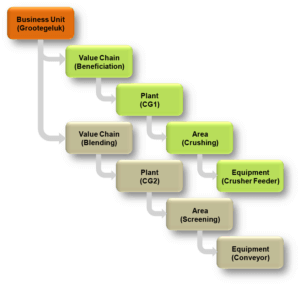
GMEP’s overall goal was to become a comprehensive coal beneficiation facility that, through the monitoring and control of crushers, screening, cyclones, larcodems (LARge COal DEnse Medium Separators) and filters as well as a complete stock yard management system, would deliver quality coal into Eskom’s Medupi silos.

Solution Selection
Exxaro has standardised on Wonderware (now IS³) technology for its coal plants so it made sense to continue building on this platform since scalability and functionality are two of its hallmarks that met the characteristics of this project. Exxaro chose system integrator Control Systems Integration (CSI) for the implementation because of the company’s ten-year successful partnership during which quality solutions have been implemented into all eleven of Exxaro’s coal facilities as well as its headquarters. CSI’s reputation for successful and value-driven industrial implementations has won the company numerous accolades and awards.

Implementation
This was a new site featuring completely automatic and integrated plant operation and control. The system has automatic start/stop procedures and PID loops are used instead of labour-intensive manual operator controllers. Automatic control allows faster start-up times, better plant availability, reduced downtime and improved reporting.

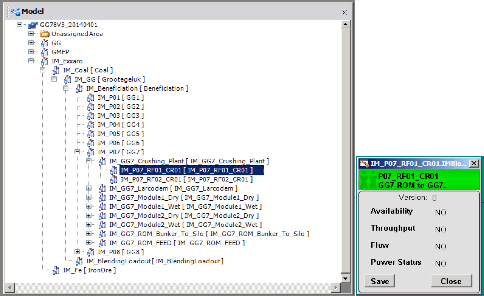
A virtual environment was created on AVEVA’s System Platform (based on ArchestrA technology) to host InTouch (HMI/SCADA), Historian and MES Performance for nine Application Object Servers (AOSs), sixteen InTouch touch panels, twelve InTouch operator stations and four engineering stations though a 200k/100k galaxy repository. At the front end were twenty PLCs servicing over 155 000 combined I/Os.

Software Toolbox’s Top Server was used for device communications. Historian captures 250Mb of data from 50 000 tags daily.

“The upfront definition of automation standards resulted in uninterrupted delivery of the automation system,” says Tinus Botes, CSI Director. “The use of AVEVA’s System Platform’s technology certainly reduced engineering costs and will also reduce training and support costs through the use of common standards and applications.”

CSI implemented a master controller system which deals with the higher-level logic functions of the plant in respect of sequences, parameters and KPIs. “This effectively provides the plant with double-tier control,” says Botes. Another aspect of the control system is the management of a special brake control procedure (designed by Binder) for the conveyor as it conveys many tons of waste back into the pit. “This was rather complicated as extensive testing was required to make sure everything worked as it should,” adds Botes. “An interesting feature was the use of a regenerative VSD drive to generate power from the braking of the inclined conveyor.”

The stockpile management function provides for the exact logging of the location of particular grades of coal in the stockyard as well as what the stackers and reclaimers were doing there before they were commissioned for other tasks. This required an interface between the stockpile management system and the various machines in the yard.

The monitoring of equipment downtime and utilisation in the plant is the responsibility of AVEVA MES (Performance). “The detailed downtime reporting available to management helps them optimise operations,” says Botes.

Challenges
“Apart from its sheer size and complexity, we had a number of memorable challenges during the implementation of this project,” says Botes. “One was interfacing to several different third-party suppliers and the integration of their solutions into the system. Another was the systematic hot-commissioning cut-over to full production, per section, while production was in full operation on previously-commissioned sections – this required some very careful scheduling. Then there were the difficulties with new technologies being implemented for the first time such as the control of the regenerative drives on the conveyors, control of the high-power brakes for the inclined conveyors and the new stockyard management system with its interface to the yard machinery. Lastly, because this was a lengthy project, we also needed to incorporate new software upgrades at the same time as everything else. ”

Benefits

  • Performance payback – Due to on-time delivery and commissioning of the project, Exxaro could claim performance against their contract with Eskom – $235 million (R3 billion) benefit to Exxaro by December 2014 (Source: Beeld Sakenuus Friday 23 August 2013).
  • Completely automatic plant (multi-level auto master control with a high-level controller controlling the plant sequences and parameters, auto start and stop procedures, auto PID control)
  • High degree of automation helps operators cope with complex processes – more so than with traditional approaches
  • Detailed AVEVA MES Performance reporting enables management to minimise operations downtime and optimise production throughput
  • Reduced engineering, support and training costs through the use of common standards and applications
  • Simplified maintenance – Downtime is captured and reported via MSSQL Reporting Services


Conclusion
“We believe that the completely automatic operation of a plant of this magnitude and complexity is due to be a noteworthy achievement that will serve Exxaro well,” says Botes. “The master control concept with its automatic start/stop procedures will effectively provide dual control over the plant which will make it easier for operators to manage a complex environment.”

This level of automatic control allows for faster start-up times, better plant availability, reduced downtime and improved reporting. Top of the agenda from the start was the definition of standards, thorough system design and detailed factory acceptance testing before moving onto the site, all of which added up to an uncommon level of implementation excellence.

Success Stories

Mining, Metals and Minerals

Exxaro GMEP

Read the success story below

Doubling the world’s largest coal beneficiation complex

Goals

  • Increase throughput from 8,750 to 14,600 tonnes per hour
  • Supply the Medupi power station with an average of 14,6Mtpa
  • Introduce high levels of operational safety
  • Employ the latest technology in coal beneficiation and plant automation
  • Provide flexibility in the coal beneficiation capacity

Solutions and Products

  • AVEVA System Platform
  • InTouch
  • Historian
  • MES Performance

Challenges

  • Working with several different third-party suppliers and integrating their solutions into the system
  • The systematic hot-commissioning cut-over to full production, per section, while production was in full operation on previously-commissioned sections
  • New technologies being implemented for the first time
  • Simultaneous incorporation of new software updates

Results

  • Significant performance payback to Exxaro by Eskom due to on-time delivery and commissioning
  • Completely automated plant
  • High degree of automation helps operators cope with complex processes
  • Minimised operations downtime and optimised production throughput
  • Reduced engineering, support and training costs
  • Simplified maintenance


Lephalale, Limpopo Province, South Africa − Exxaro Grootegeluk coal mine plays a vital role in the South African economy by supplying upgraded coal to Eskom’s Matimba power station which contributes nearly 4000 MW to a struggling national grid. With the creation of the Medupi power station, the mine has had to virtually double its coal supply to accommodate this new 4800MW facility. When Medupi is complete, Grootegeluk will be responsible for supplying two power stations that together will meet more than 20% of the country’s electricity needs.

Namibia Breweries Limited

“It is an amazing feeling to see the end result and the satisfaction on the faces of the end users. It is also amazing to see the value that the business has derived from this.”

André Engelbrecht, Manager: Industrial Control Systems, NBL

Windhoek, Namibia

Optimal utilities management contributes to a greener environment and a healthier bottom line at Namibia Breweries Limited (NBL) where AVEVA Historian from IS³ helps to generate daily, weekly and monthly consumption reports for water, electricity, chemicals, thermal energy, solar generation, carbon dioxide and air and to compare results with KPI targets.

Linking Historian tags to the company’s production system has also led to faster and more accurate problem detection.

Background
With regard to renewable energy, NBL has put into practice what others only talk about. The company has a 1MW roof-mounted solar plant with more than 4000 panels, 66 inverters and 4 cluster controllers. The whole system is connected to three of the company’s generator sections. When it was installed in 2013, it was the largest hybrid system in the world and it also made NBL completely self-sufficient regarding electrical power.

But this was only the start. Electricity, though a major component, is only one factor in the complex world of utilities which, today, are highly significant contributors to product costs, competitiveness and profitability. And there’s more to effective utilities management than simply watching the meter.

A Manufacturing Operations Management Survey conducted by LNS Research showed that the top two operational challenges for meeting Strategic Manufacturing Objectives were that companies had to deal with disparate systems and the lack of cooperation across their different departments.

“In our case, we have the brewing, packaging and distribution departments,” says André Engelbrecht, Manager: Industrial Control Systems, NBL “Each of them focuses on doing their job to the best of their ability but without necessarily much concern for the common denominator that makes it all possible; utilities.”

And so NBL decided to unify their various departments into a cohesive entity that could make real-time business decisions with regard to utility usage based on a single version of the facts.

The scope of the implementation would include access to the CO2 plant, NH3 Ammonia cooling, boiler house, water treatment plant, sterile air plant and power meters.

Implementation

The project was started in February 2015 and changeover to the new system was done after a two-week parallel operation during January and February 2016. But according to Engelbrecht, this is not the end as it is a “living” system designed to grow and supply the company’s information needs well into the future.

NBL has a central DCS which controls the beer-making process from beginning to end but achieving NBL’s goals of accurate decision support based on reality and real-time production information, more data collection and collation resources would be needed.

“It was vitally important that we got the buy-in from all stakeholders regarding the value of doing this, after which we decided to use the power of AVEVA Historian and the scripting capabilities of Historian Client,” says Engelbrecht.

“We also installed Software Toolbox’s TOP Server to retrieve data from our utility plants and systems and used the DCS to build a SCADA system. We then developed a web-reporting system for production personnel and a dashboard system for management. Most of our physical servers are now hosted in a virtual environment and this has made things a lot easier, such as time synchronization between the old Historian and the OPC server.”

NBL configured a virtual enterprise consisting of two TOP Servers (to balance the load of more than 100 PLCs and systems), one DataHub Server, AVEVA Historian, the main historian data warehouse and a web server. A secure HTTPS dashboard server enables management to view daily and monthly sales and operational KPIs from anywhere and weekly real-time stock volumes are sent to NBL’s advanced planning system using Historian Client queries. SAP files are imported daily regarding sales, production, logistics and depot information.

The system lets qualified personnel view various utility consumption and production information at the same time wherever they may be. They’re also able to view daily, weekly and monthly consumption information on the same platform. In future NBL will be able to switch off non-critical plant equipment to ensure that their maximum demand remains below target.

“It is great to see what can be done with technology and data when you use the right tools such as the [AVEVA] products we implemented in this project. It was also a great learning experience to combine the products we chose to enable us to make our end-results and user-experience better and more effective,” says Annemarie Kruger, MES/MIS Specialist, NBL.

“In my opinion, some of the most outstanding features of the system include its open standards, the wide range of drivers available, its scalability (as big as we want to go) as well as its ease of use, customisation and integration facilities with other initiatives,” adds Engelbrecht. “This implementation was all about 80% planning and 20% implementation. AVEVA’s Customer FIRST Support Programme is a must and the support from IS³ and Software Toolbox was outstanding.”

About Namibia Breweries Limited (NBL)

As part of the Ohlthaver & List (O&L) Group, the company is proud to uphold the tradition established in 1516 and brew their beer according to the Reinheitsgebot Purity Law resulting in products renown for their incomparable quality and purity.

The exceptional brands in their portfolio continues to garner international recognition, winning a series of gold medals during the prestigious Deutsche Landwirtschafts Gesellschaft (DLG) Awards.

And it’s quite a portfolio, comprising 11 brands including Windhoek, Tafel, Hansa, Heineken and Amstel to name a few.

In 2019, NBL celebrated its 100th birthday

Success Stories

Food and Beverage

SAB-ABI (AB InBev) Packaging Line Performance

Read the success story below

Doubling the world’s largest coal beneficiation complex

Goals

  • Increase throughput from 8,750 to 14,600 tonnes per hour
  • Supply the Medupi power station with an average of 14,6Mtpa
  • Introduce high levels of operational safety
  • Employ the latest technology in coal beneficiation and plant automation
  • Provide flexibility in the coal beneficiation capacity

Solutions and Products

  • AVEVA System Platform
  • InTouch
  • Historian
  • MES Performance

Challenges

  • Working with several different third-party suppliers and integrating their solutions into the system
  • The systematic hot-commissioning cut-over to full production, per section, while production was in full operation on previously-commissioned sections
  • New technologies being implemented for the first time
  • Simultaneous incorporation of new software updates

Results

  • Significant performance payback to Exxaro by Eskom due to on-time delivery and commissioning
  • Completely automated plant
  • High degree of automation helps operators cope with complex processes
  • Minimised operations downtime and optimised production throughput
  • Reduced engineering, support and training costs
  • Simplified maintenance


Lephalale, Limpopo Province, South Africa − Exxaro Grootegeluk coal mine plays a vital role in the South African economy by supplying upgraded coal to Eskom’s Matimba power station which contributes nearly 4000 MW to a struggling national grid. With the creation of the Medupi power station, the mine has had to virtually double its coal supply to accommodate this new 4800MW facility. When Medupi is complete, Grootegeluk will be responsible for supplying two power stations that together will meet more than 20% of the country’s electricity needs.

The use of AVEVA System Platform’s technology certainly reduced engineering costs and will also reduce training and support costs through the use of common standards and applications.”

Tinus Botes, Director, Control Systems Integration

Scope of the Grootegeluk Medupi Expansion Project (GMEP)
This is one of the largest mining growth projects in Southern Africa with a capital cost expected to total $800 million (R10,2 billion). On completion, Grootegeluk will be the largest coal operation in the world, producing some 33Mtpa of power station, coking and steam coal powering nearly 9000MW. On the mining side, the project incorporates cutting edge mining techniques including semi-mobile in-pit crushing systems. On the supervisory side, all the industrial automation and information aspects had to be completed in two years.

The scope of the industrial automation aspect of the GMEP included the development of 19 different functional design specifications, assembling 20 PLC panels as well as 192 remote I/O and 80 condition monitoring panels, installing 48 process cameras and associated networks, developing control standards, PLC coding and SCADA configuration, production reporting, full factory acceptance testing, site installation and interfacing to third-party vendor equipment – and then came cold commissioning in parallel with the operational facility as well as the systematic hot commissioning and cut-over to full production.

Project Goals

  • Looking at the following, it would seem that the brevity of the goals is inversely proportional to the quantity and quality of ingenuity, effort and resources that have to be invested in their realisation:
  • Increase throughput from 8,750 to 14,600 tonnes per hour
  • Supply the Medupi power station with an average of 14,6Mtpa
  • Introduce high levels of operational safety
  • Employ the latest technology in coal beneficiation and plant automation
  • Provide flexibility in the coal beneficiation capacity

GMEP’s overall goal was to become a comprehensive coal beneficiation facility that, through the monitoring and control of crushers, screening, cyclones, larcodems (LARge COal DEnse Medium Separators) and filters as well as a complete stock yard management system, would deliver quality coal into Eskom’s Medupi silos.

Solution Selection
Exxaro has standardised on Wonderware (now IS³) technology for its coal plants so it made sense to continue building on this platform since scalability and functionality are two of its hallmarks that met the characteristics of this project. Exxaro chose system integrator Control Systems Integration (CSI) for the implementation because of the company’s ten-year successful partnership during which quality solutions have been implemented into all eleven of Exxaro’s coal facilities as well as its headquarters. CSI’s reputation for successful and value-driven industrial implementations has won the company numerous accolades and awards.

Implementation
This was a new site featuring completely automatic and integrated plant operation and control. The system has automatic start/stop procedures and PID loops are used instead of labour-intensive manual operator controllers. Automatic control allows faster start-up times, better plant availability, reduced downtime and improved reporting.

A virtual environment was created on AVEVA’s System Platform (based on ArchestrA technology) to host InTouch (HMI/SCADA), Historian and MES Performance for nine Application Object Servers (AOSs), sixteen InTouch touch panels, twelve InTouch operator stations and four engineering stations though a 200k/100k galaxy repository. At the front end were twenty PLCs servicing over 155 000 combined I/Os.

Software Toolbox’s Top Server was used for device communications. Historian captures 250Mb of data from 50 000 tags daily.

“The upfront definition of automation standards resulted in uninterrupted delivery of the automation system,” says Tinus Botes, CSI Director. “The use of AVEVA’s System Platform’s technology certainly reduced engineering costs and will also reduce training and support costs through the use of common standards and applications.”

CSI implemented a master controller system which deals with the higher-level logic functions of the plant in respect of sequences, parameters and KPIs. “This effectively provides the plant with double-tier control,” says Botes. Another aspect of the control system is the management of a special brake control procedure (designed by Binder) for the conveyor as it conveys many tons of waste back into the pit. “This was rather complicated as extensive testing was required to make sure everything worked as it should,” adds Botes. “An interesting feature was the use of a regenerative VSD drive to generate power from the braking of the inclined conveyor.”

The stockpile management function provides for the exact logging of the location of particular grades of coal in the stockyard as well as what the stackers and reclaimers were doing there before they were commissioned for other tasks. This required an interface between the stockpile management system and the various machines in the yard.

The monitoring of equipment downtime and utilisation in the plant is the responsibility of AVEVA MES (Performance). “The detailed downtime reporting available to management helps them optimise operations,” says Botes.

Challenges
“Apart from its sheer size and complexity, we had a number of memorable challenges during the implementation of this project,” says Botes. “One was interfacing to several different third-party suppliers and the integration of their solutions into the system. Another was the systematic hot-commissioning cut-over to full production, per section, while production was in full operation on previously-commissioned sections – this required some very careful scheduling. Then there were the difficulties with new technologies being implemented for the first time such as the control of the regenerative drives on the conveyors, control of the high-power brakes for the inclined conveyors and the new stockyard management system with its interface to the yard machinery. Lastly, because this was a lengthy project, we also needed to incorporate new software upgrades at the same time as everything else. ”

Benefits

  • Performance payback – Due to on-time delivery and commissioning of the project, Exxaro could claim performance against their contract with Eskom – $235 million (R3 billion) benefit to Exxaro by December 2014 (Source: Beeld Sakenuus Friday 23 August 2013).
  • Completely automatic plant (multi-level auto master control with a high-level controller controlling the plant sequences and parameters, auto start and stop procedures, auto PID control)
  • High degree of automation helps operators cope with complex processes – more so than with traditional approaches
  • Detailed AVEVA MES Performance reporting enables management to minimise operations downtime and optimise production throughput
  • Reduced engineering, support and training costs through the use of common standards and applications
  • Simplified maintenance – Downtime is captured and reported via MSSQL Reporting Services


Conclusion
“We believe that the completely automatic operation of a plant of this magnitude and complexity is due to be a noteworthy achievement that will serve Exxaro well,” says Botes. “The master control concept with its automatic start/stop procedures will effectively provide dual control over the plant which will make it easier for operators to manage a complex environment.”

This level of automatic control allows for faster start-up times, better plant availability, reduced downtime and improved reporting. Top of the agenda from the start was the definition of standards, thorough system design and detailed factory acceptance testing before moving onto the site, all of which added up to an uncommon level of implementation excellence.

The accuracy of the downtime reports is such that even the OEM is using them to troubleshoot their equipment in preference to the manual tracking sheets they normally use when commissioning.”

John Coetzee, SAB Business Systems Manager, Manufacturing
Success Stories

Food and Beverage

SAB-ABI (AB InBev) Packaging Line Performance

Read the success story below

Doubling the world’s largest coal beneficiation complex

Goals

  • Increase throughput from 8,750 to 14,600 tonnes per hour
  • Supply the Medupi power station with an average of 14,6Mtpa
  • Introduce high levels of operational safety
  • Employ the latest technology in coal beneficiation and plant automation
  • Provide flexibility in the coal beneficiation capacity

Solutions and Products

  • AVEVA System Platform
  • InTouch
  • Historian
  • MES Performance

Challenges

  • Working with several different third-party suppliers and integrating their solutions into the system
  • The systematic hot-commissioning cut-over to full production, per section, while production was in full operation on previously-commissioned sections
  • New technologies being implemented for the first time
  • Simultaneous incorporation of new software updates

Results

  • Significant performance payback to Exxaro by Eskom due to on-time delivery and commissioning
  • Completely automated plant
  • High degree of automation helps operators cope with complex processes
  • Minimised operations downtime and optimised production throughput
  • Reduced engineering, support and training costs
  • Simplified maintenance


Lephalale, Limpopo Province, South Africa − Exxaro Grootegeluk coal mine plays a vital role in the South African economy by supplying upgraded coal to Eskom’s Matimba power station which contributes nearly 4000 MW to a struggling national grid. With the creation of the Medupi power station, the mine has had to virtually double its coal supply to accommodate this new 4800MW facility. When Medupi is complete, Grootegeluk will be responsible for supplying two power stations that together will meet more than 20% of the country’s electricity needs.

Success Stories

Food and Beverage

SAB-ABI (AB InBev) Packaging Line Performance

Read the success story below

SAB manages the big picture with help from IS³

South Africa Breweries Limited (SAB), a division of AB InBev, is a vast, geographically-distributed network of breweries involved with complex production processes that have to satisfy the demands of millions of discerning customers in real-time. While this may sound challenging enough for the management of a single brewery, coordinating the efforts of seven manufacturing regions so as to provide an in-depth, unified and comprehensive vies of KPIs was best done with help from an application known as Enterprise Manufacturing Intelligence or EMI

Introduction

Before this project, there were limited facilities to proactively monitor critical systems in SAB’s beer manufacturing systems department and this led to the requirement for the implementation of a centralised monitoring system that would detect and warn about mission-critical manufacturing systems within SAB that were in difficulty with respect to meeting their KPIs.

Although distributed in nature, manufacturing enterprises such as SAB still need to operate as unified entities with respect to meeting their business objectives and it is in this regard that the company looked for a solution that would provide a collated picture of its production facilities and that made the best use of its existing information assets while providing the least change to operators and users.

About The South African Breweries Limited (SAB)

Founded in 1895, SAB is the South African subsidiary and historical birthplace of SABMiller plc, one of the world’s largest brewers by volume with more than 200 brands and brewing interests and distribution agreements in over 60 countries across six continents.

SAB is the second largest listed company on the JSE Securities Exchange, South Africa’s leading producer and distributor of alcoholic and non-alcoholic beverages and one of the nation’s largest manufacturing firms.

About The South African Breweries Limited (SAB)

The company operates seven breweries and 42 depots in South Africa with an annual brewing capacity of 3.1 billion litres. Its portfolio of beer brands meets the needs of a wide range of consumers and includes brands rich in heritage such as Castle Lager, Hansa Pilsner, Carling Black Label and the iconic Dutch beer brand Grolsch.

SAB employs more than 9,000 people, 75% of whom are from previously disadvantaged groups. In addition SAB’s operations support an estimated 48,000 jobs at SAB’s first round suppliers. For each job offered by SAB and its first round suppliers, 5.7 additional jobs are supported in the rest of the South African economy. In all 378,000 full time jobs in South Africa can directly or indirectly be traced back to the production of SAB’s products.

Project objectives

Project Dash (short for the dashboard view it was to provide into the individual and collated production facilities of SAB) was started and it had to plug some important information holes by:

  • Providing a centralised system for the early detection and warning of mission-critical problems
  • Implementing a centralised data repository for analysis purposes
  • Identifying key KPIs for PLCs, AVEVA Historian, System Platform and MES hardware and software systems for all seven beer manufacturing regions
  • Presenting the information in dashboard format so that it could be easily read, interpreted and viewed from a divisional level at head office.

Solution selection

“We selected AVEVA Intelligence, supplied by IS³, because not only would it provide the functionality we were looking for but it would also fit into SAB’s strategic architecture and alignment with our standardising on the Application Server (part of AVEVA System Platform),” says Hein du Toit, Business Analyst at SAB Limited. “Buying into suite-based products gives long term value and it also gave us seamless access to time-based AVEVA Historian production data. It also allowed us to plug into MS SQL databases for MES and other applications.”

One of the main functions of any EMI application such as AVEVA Intelligence is to collate data from a wide and often disparate number of sources and to provide data warehousing, data aggregation as well as roll-up and drill-down functionality. But this information is less than helpful if it can’t be displayed in a format that is easy to define and understand. “[AVEVA] Intelligence provides user-friendly, drag-and-drop dashboarding functionality,” says du Toit. “Once you have explored the Dashboarding tool, Tableau Server, it really does make creating dashboards easy. It is an extremely powerful tool.”

Since it’s an SAB rule that all system integrator work done on the System Platform be performed by ArchestrA-Certified SIs, SAB chose system integrator Advansys for the implementation.

The accuracy of the downtime reports is such that even the OEM is using them to troubleshoot their equipment in preference to the manual tracking sheets they normally use when commissioning.”

John Coetzee, SAB Business Systems Manager, Manufacturing

Advansys has a good knowledge of the Food and Beverage industry in general and the brewing industry in particular. “[Their] specific advantage is knowledge of not only the beer making process but also the manufacturing system architecture that we use such as our eQMS, which is our quality/MES system,” says du Toit.

In addition, if any custom development had to be done, the expert use of the ArchestrA Application Object Toolkit was important. This gives the ability for any custom development to conform with SAB’s architecture and standards while making it easy for the engineers at regional level to understand and maintain the system.

“Lastly, AVEVA Intelligence is a Business Intelligence tool and Advansys’s knowledge of data warehousing was important to understand and implement the project on a tight timeline,” concludes du Toit.

Implementation

“Starting at the regional level, we wanted to make use of the existing infrastructure at the regions and did not want to introduce anything that would affect the performance of the historians, application object servers or even the PLCs,” says du Toit.

The project team drew up the required regional system architecture shown in figure 1 which collates KPIs from the PLCs as well as the Historians and MES servers for storage in the regional data warehouse from which it can be extracted and viewed in dashboard form according to the needs of users.

This regional architecture was replicated seven times for each of the regions and connected to the central data warehouse at head office, where the dashboard views not only represent an aggregated picture but also allow drilling down to the views of each region independently.

“SAB stipulated that we make use of the existing ArchestrA System Platform install-base, providing centralised change management, change propagation and it’s user-friendly Integrated Development Environment (IDE) for all data retrieval configuration,” says Advansys Director Graeme Welton.

The main reasons for this were that SAB didn’t want another system to maintain and ArchestrA is already the standard system control platform at all the breweries. Systems engineers are familiar with its IDE and the System Platform provides built-in change propagation and object derivation, a deployment installation model as well as an integral security model. In other words, everything was in place to allow Advansys to focus on the Intelligence application and not spend engineering time on fundamentals.

This phase of project Dash focused on collecting and collating diagnostic data with respect to system performance, traffic volumes, CPU usage, scan times, memory usage, message status (MSMQ), I/O Server item counts (total, active, etc.), disc space availability, unprocessed SQL messages and many more. This would include everything from the PLC, Server Platform, the process and the ArchestrA engine to the I/O Server, the file system, Microsoft Message Queue and any SQL database (MES).

“Because of the nature of this data, most of which comes from operating system diagnostics, as well as SAB’s requirement to use ArchestrA, we decided to use the ArchestrA Object Toolkit which gave us full use of the ArchestrA Object Framework and access to low-level C#.Net coding,” says Welton. “This approach also allowed us to use standard, out-of-the-box alarm and history primitives and compile editors for easy configuration. This all meant that no scripting was required for engineers to configure the data retrieval objects.”

Welton believes that the dashboard development tool is much more than it appears at first and that IS³ has produced a solution whereby almost anyone with some basic training can collect and collate information from virtually any combination of sources to suit their needs. “This is rather different from traditional Business Intelligence tools that require large IT teams to support and develop.”

Benefits

“I feel I should comment on three important aspects of the project,” says du Toit. “First of all, time; after the testing and development phase, we were able to roll out the project to the rest of the sites and commission within 2 months! 

This is a reflection on the power of the underlying ArchestrA technology. Then there’s the matter of cost. The time saved with the project roll-out had a direct impact on the cost and we were able to finish within budget. The third point is the exceptional quality of the work delivered by Advansys.”

  • One immediate benefit was risk reduction. With an immediate view of the status of each system, engineers were able to detect issues that impact performance of the various systems under scrutiny.
  • Cross-platform comparison and analysis make decision making easy when deciding on deployment of areas.
  • Cross-regional analysis shows trends and areas to focus on for development or where support should be given.

I believe that the dashboard development tool is much more than it appears at first and that IS³ has produced a solution whereby almost anyone with some basic training can collect and collate information from virtually any combination of sources. This is rather different from typical Business Intelligence tools that require large IT teams to support and develop.”

Graeme Welton, Director, Advansys
Success Stories

Water and Wastewater

Rand Water

Read the success story below

Rand Water chooses AVEVA’s System Platform for its Control Centre

Goals
The integration of a vast and geographically distributed information network to support regional and central decision-making
Remote measurement of mission-critical variables such as water flow and quantity, pH, turbidity, chlorine levels, conductivity, reservoir levels and pipeline pressures
Calculation of water balances in order to assist with the identification of problem areas, faulty instruments as well as the calculation of the network’s efficiency in future

Solutions and Products
AVEVA System Platform
AVEVA InTouch
AVEVA Historian

Results
A single and integrated business view and control of Rand Water’s extensive network assets through the integration of its insular control systems

Background
Established in 1903, Rand Water is the largest water utility in Africa, delivering on average 3.5 million tons (3500 million litres) of some of the purest drinking water in the world to approximately 11 million people every day through local authorities, large industries and mines. The success of such an operation depends on the smooth running of a vast distribution network spanning 18 000 km2 plus 13 000 km2 of which is shared with other water utilities. With an annual turnover of more than R3 billion and assets in excess of R5 billion, customer satisfaction through the effective management, control and utilisation of its water delivery infrastructure is top of the agenda at Rand Water.

The Rand Water network consists of 2 major water treatment sites, 13 booster pumping stations, 3000 km of pipelines, 32 storage reservoirs and approximately 1500 customer meters (e.g. municipalities).

This network is supervised by a wide range of control systems including a variety of PLCs, SCADA systems, meters as well as a diverse range of data networks and protocols.

Rand Water’s province-sized “shop floor” required an approach that would help it integrate control and collate information in order to optimise the use of existing assets and streamline infrastructure utilisation. The time had come to aggregate the information from the distributed databases and to make this information available to operational management for monitoring the whole operation of bulk water supply throughout Rand Water’s network at a glance. This was the start of the ArchestrA-based Rand Water Control Centre project.

Rand Water

“What appealed to us about AVEVA ArchestrA technology, was that it provided the “Galaxy” concept for the unification of networks and information repositories through a single transparent tag name database. Although they are geographically distributed over the whole of Gauteng and beyond, we can now treat all our sites as a single entity or Galaxy”.

– Les Lange, Rand Water

The project goals include:

  • Remote measurement of mission-critical variables such as water flow and quantity, pH, turbidity, chlorine levels, conductivity, reservoir levels and pipeline pressures.
  • Calculation of water balances in order to assist with the identification of problem areas, faulty instruments as well as the calculation of the network’s efficiency in future.
  • Central monitoring of water quantity and quality
  • Central overview / dashboard of operations
  • Central alarming and reporting
  • Integration of a variety of disparate systems
  • Linking up systems and meters not yet on the LAN/WAN

‘Due to its scope, the Control Centre project is more of a journey rather than a project,’ says Les Lange of Rand Water. ‘What appealed to us about Wonderware’s ArchestrA, was that it provided the “Galaxy” concept for the unification of networks and information repositories through a single transparent tag name database. Although they are geographically distributed over the whole of Gauteng and beyond, we can now treat all our sites as a single entity or Galaxy. This will eliminate islands of information and present us with a unified and centralised information repository that is available to all. This approach is also leading to an easier development and deployment of standards through a central control point that is also facilitating software change management. The other reasons we chose Wonderware are their large installed base both locally and world-wide as well as the strong local support and availability of skills.’

Most KPIs defined at the start of the project are now available, the various disparate systems are being integrated and the operations staff are very satisfied with developments.

‘We’ve found integration with ArchestrA to be easy,’ says Dries van Schalkwyk of Control Systems Integration. ‘DDE, Suitelink, OPC … anything goes. The ArchestrA environment is also helping to reduce engineering costs through the development, deployment and maintenance of standards such as the S88 naming convention. These now apply to the whole organisation.’

ArchestrA’s use of object technology means that the information, control, alarming and other criteria for plant items such as pumps and valves is defined in a template. If a change is required, only the template needs to be edited and this change will then automatically propagate to every instance of that item in the network. ‘This makes it easy to define and maintain standards and also reduces engineering costs when installing a new plant or maintaining an existing plant,’ adds Lange.

The Rand Water ArchestrA area model (Figure 3) consists of geographical areas and sites (treatment sites, booster pumping stations, pipelines and storage reservoirs) as well as distribution zones (pipeline service areas).

‘We see ArchestrA as an excellent solution for our needs,’ says Lange. ‘It maps well to our primary objective of an integrated and unified “shop floor” and provides the necessary infrastructure to safeguard our extensive existing investments and assets.’

Success Stories

Food and Beverage

SAB-ABI (AB InBev) Packaging Line Performance

Read the success story below

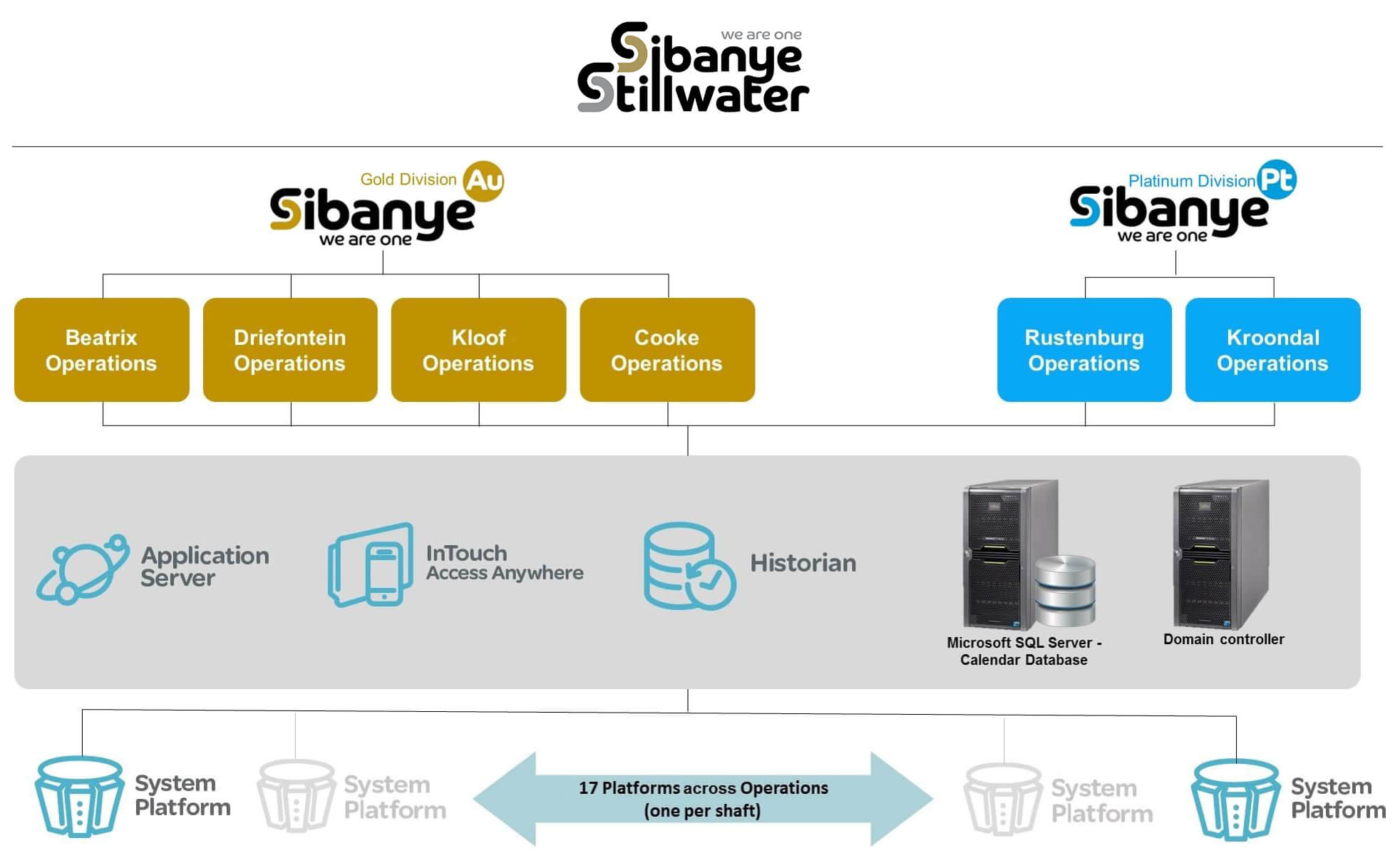
Enterprise-wide power management gives Sibanye-Stillwater’s mines the control they need

Goals
The implementation of an enterprise-wide power control solution that would meet Sibanye-Stillwater’s geographically-distributed needs


Challenges

  • A singular application that spanned across and satisfied the needs of all Sibanye-Stillwater’s operations
  • Perform automated load shifting
  • Automated load clipping
  • Centrally-managed control of the system, its equipment, and its schedules
  • Continue operation in spite of network outages


Results

  • The SCADA system is now a single application spanning across all of Sibanye-Stillwater’s operations
  • Management has access to all data and information across the enterprise
  • Centralised energy control
  • Flexible system
  • More deployments of this successful solution into new mines


Solutions & Products

  • AVEVA System Platform
  • AVEVA InTouch
  • AVEVA Historian
  • AUVESY-MDT AutoSave for System Platform

Sibanye-Stillwater

“The versatility of AVEVA’s System Platform and integrated solutions provided  by IS³ gave us the flexibility we needed to cope with decentralised operations and to standardise our approach to power management across the enterprise.”

 – PJ Jansen van Rensburg, ICT Manager – Networks and Engineering Systems, Sibanye-Stillwater

South Africa and Zimbabwe
A key cost factor in mining is electrical energy and Sibanye-Stillwater’s extensive, geographically-dispersed operations involved in the mining of gold, platinum and uranium, uses a lot of it. So much so that they saw the need for a holistic, enterprise-wide approach to the problem to replace the discrete and numerous solutions that had evolved over the years.


Background
Sibanye purchased a number of mines, each of which had evolved their own solution to the power management problem over many years. In fact, all these solutions added up to no less than 39 stand-alone applications across the company’s operations.

“Multiple energy control projects at the different operations resulted in many proprietary third-party systems being used for scheduling,” says P.J. Jansen van Rensburg, ICT Manager, Networks and Engineering Systems, Sibanye-Stillwater. “Any energy control schedule configuration was done in isolation of the others and their inflexibility caused some contradictory control problems such as different priorities seen from the perspective of the solution vendors – even at the same site. This resulted in management not having access to all applications and their information.”

But the problems didn’t end there. Sibanye-Stillwater’s production activities were not synchronised with Eskom’s tariff structures with regard to load shifting (moving the load demand to non-peak times) and load clipping (limiting the load to set limits). And lastly, there was no standardisation across all 32 SCADA systems in use at the time.

Implementation
Sibanye-Stillwater launched an initiative to implement an enterprise-wide power control module that would meet the following criteria:

Consist of a singular application that spanned across and satisfied the needs of all Sibanye-Stillwater’s operations
Perform automated load shifting
Maintain usage within limits at all times (automated load clipping)
Provide centrally-managed control of the system, its equipment and its schedules
Continue operation in spite of network outages
“We chose a decentralised infrastructure model, which meant that, in the event of a hardware failure, only the local site would be affected while each Sibanye operation, shaft and PLC would be able to run independently in case of a communication failure,” says van Rensburg. “The solution that ticked all the boxes was [AVEVA’s] System Platform.”

“To better understand what the total power control module needed to do, it’s important to understand Eskom’s two-part tariff system,” says van Rensburg. “This consists of Load Shifting which means scheduling machinery to either stop working altogether or run unloaded during Eskom’s peak periods (18:00 to 20:00 in summer and 17:00 to 19:00 in winter – 2.5 times the rate for non-peak consumption). Then there’s Load Clipping which is done by unloading machinery during Eskom’s peak and standard tariff periods as per set targets.”

So schedules were created, configured and activated to cope with Load Shifting while targets were set and algorithms created and deployed to handle the Load Clipping aspect of power control. “Because of its real-time nature, we still can’t do Load Clipping during network failure,” explains van Rensburg. “But Load Shifting is no longer a problem because a register for the next 20 operations is programmed into the PLC every few seconds which means that it can continue to independently shift loads for up to a week if necessary.”

“Standardisation is crucial to operator efficiency it they change plants but it also provides a standardised communication ‘language’ and understanding between everyone involved who all have access to this production information. This lets them benchmark and compare their accomplishments to other plants because they all share a common standard for performance,” says van Rensburg.

Results

  • The current SCADA system is now a single application spanning across all of Sibanye-Stillwater’s operations.
  • Management now has access to all data and information across the enterprise.
  • All energy control projects can be controlled centrally and projects are underway to move to central control.
  • This system is flexible enough to allow for continuous improvements and savings.
  • Sibanye has acquired more mines and the system is being successfully implemented into these new ventures

About Sibanye-Stillwater
Sibanye-Stillwater owns and operates high-quality gold and platinum operations in South Africa – consolidated into one Group with one vision and strategy. The long-term success of Sibanye-Stillwater as a business and as a responsible corporate citizen is dependent on all stakeholders working together as one.

Success Stories

Power and Gas Utilities

Egoli Gas (Pty) Ltd

Read the success story below

Egoli Gas saves 95% of personnel time and energy through automated network monitoring

Goals

  • Meet customer needs while looking after network safety
  • Reduce meter reading time and costs
  • Improve knowledge of imported and delivered gas as well as network status in real time

Challenges

How to implement GSM-based data acquisition technology at remote locations with power and security problems

Results

  • Considerable reduction in personnel time and travelling costs
  • Accurate monitoring of pressures to look after customer requirements and the network’s safety
  • Reduction in maintenance personnel and effort
  • Accurate reconciliation of imported and exported gas
  • Speedy response to faults/issues
  • Real-time knowledge of network health and status
  • The system will be expanded to detect leaks and illegal taps

Solutions & Products

  • System Platform
  • Historian
  • Historian Client
  • InTouch

Egoli Gas (Pty) Ltd

“Thanks to Systems Anywhere’s ingenuity and AVEVA solutions from IS³, we are one of the best if not the best utility in Johannesburg. During the extensive load-shedding of 2015, a major bank customer thanked us for our reliability and swift response in meeting the requirements of their tri-generation plants – all due to our informed personnel and information suppliers.”

Emmanuel Matodzi, Projects and Planning Engineer, Egoli Gas

Johannesburg, Gauteng, South Africa
With a “shop floor” covering the greater Johannesburg metropolitan area, Egoli Gas had an understandable problem reading their meters and getting a grip on the true status of their vast pipe network. Today, manual data collection is a thing of the past and Egoli Gas can do a better job of looking after its customers by meeting their needs in real time.


Background
Prior to the installation of this new system, Egoli Gas personnel would drive to 7200 gas meters in a 1800 km-long network covering a large portion of the greater Johannesburg metropolitan area, They would log consumption data for processing in Excel from which very basic reports were generated for management.

This entirely manual process was prone to human error, unsynchronised meter readings and further time delays in generating the reports. The result was an inefficient operation and delayed response to issues affecting gas delivery to Egoli Gas’ clients.

“As a utility company with many important customers, our challenges were numerous,” says Emmanuel Matodzi, Projects and Planning Engineer at Egoli Gas. “How do we read all the 7500 meters in our network or how do we ensure that none of the sectors in our network is being starved of gas or is experiencing low pressure – especially in times of sudden demand from our clients who use gas for power generation during power load shedding?”

But that’s only half the story. At any moment in time, Egoli Gas couldn’t readily reconcile the volume of gas they bought from SASOL with the amount supplied to their customers until the tedious and time-consuming process of manual data collection was completed – so reducing the time and cost of personnel travelling their vast network had to be addressed.

And the list goes on: How could Egoli Gas be proactive in pre-empting unwanted high pressures in their ageing network which isn’t only undesirable for the network but especially for their customers whose equipment may be designed to cope with 3 rather than 25 kPa? How can the company address the problem of detecting theft and leaks? Then there was the real need to know at all times how much gas capacity was in reserve as well as the health of the entire network.

This was all about bringing decades-old but vital energy technology into the 21st century with all its attendant problems and challenges. What’s more, whatever solution was chosen could not rely on human intervention and had to be entirely reliable since the profitability of Egoli Gas and the satisfaction of its customers depended on it.

Egoli Gas took a bold decision to address all these issues once and for all. Their goal was to develop a gas network monitoring solution using solar-powered GSM data acquisition technology and to log the data automatically in order to provide reports on gas distribution and consumption – all in real time while also addressing the issues of power availability at remote locations as well as that of vandal-proofing.

Implementation
Egoli Gas selected AVEVA-certified system integrator Systems Anywhere for the implementation of this landmark project who decided to build on Egoli Gas’ existing Wonderware-based industrial information infrastructure.

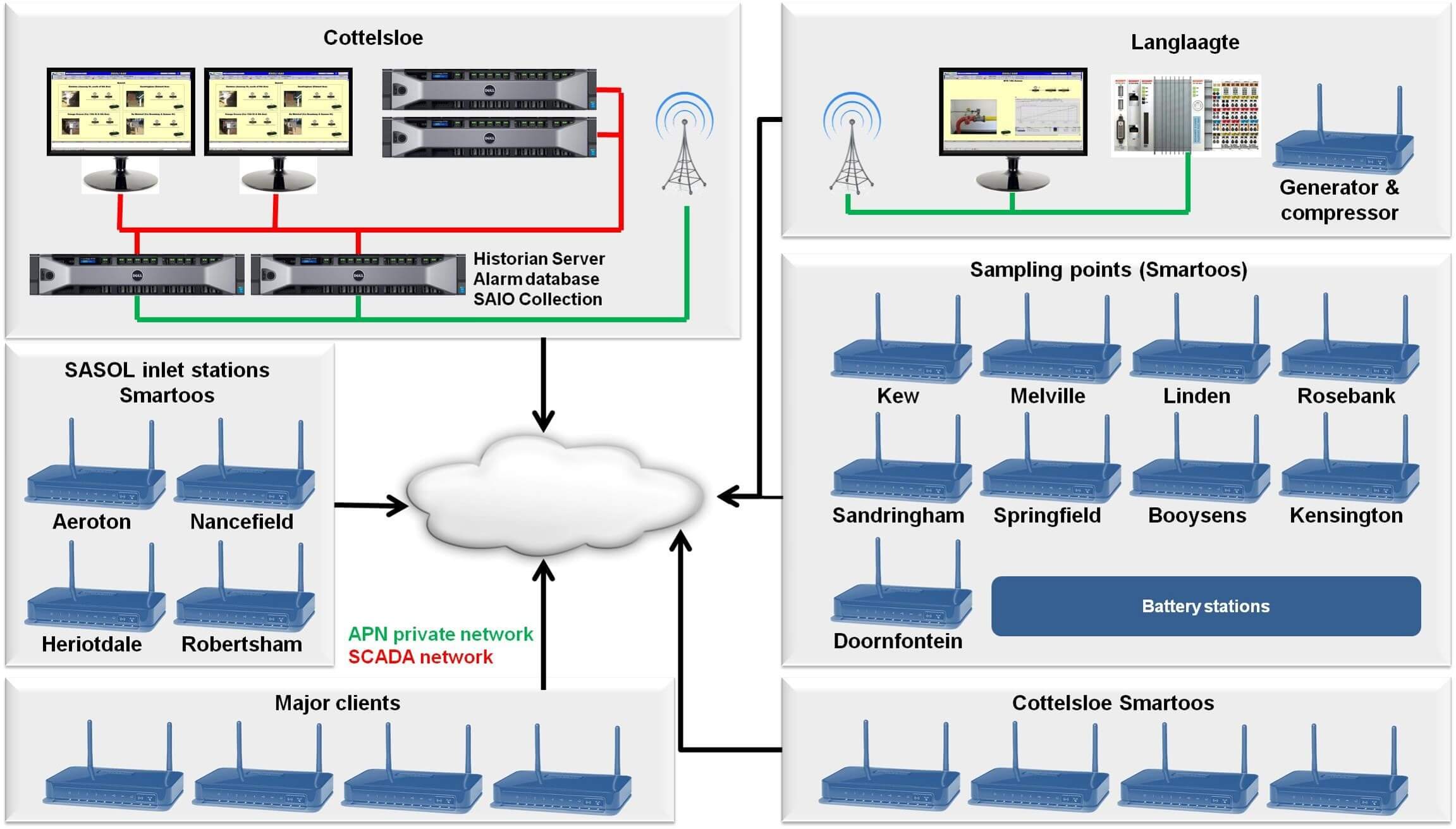
Systems Anywhere designed a cost-effective solar-powered, vandal-proof logging station (Smartoos) for use at all measuring nodes to log gas volume, pressure and temperature in order to determine the gas supply conditions at all these delivery points. Readings are transmitted via private APN every 2 minutes to the Cottesloe “Starfish” with a Port-Forwarding configuration.

“This alone resulted in huge savings in terms of personnel and travelling costs as well as time,” says Matodzi. “In fact, we estimate that time and cost savings to be about 95% with 100% improvement in the quality of data – not only in its accuracy but also in its near-real-time delivery. The system also provides every department with the information they need. For example, account managers now know precisely what their key accounts are doing and can advise them accordingly and our own accountants know precisely how much gas we’re importing and distributing.”

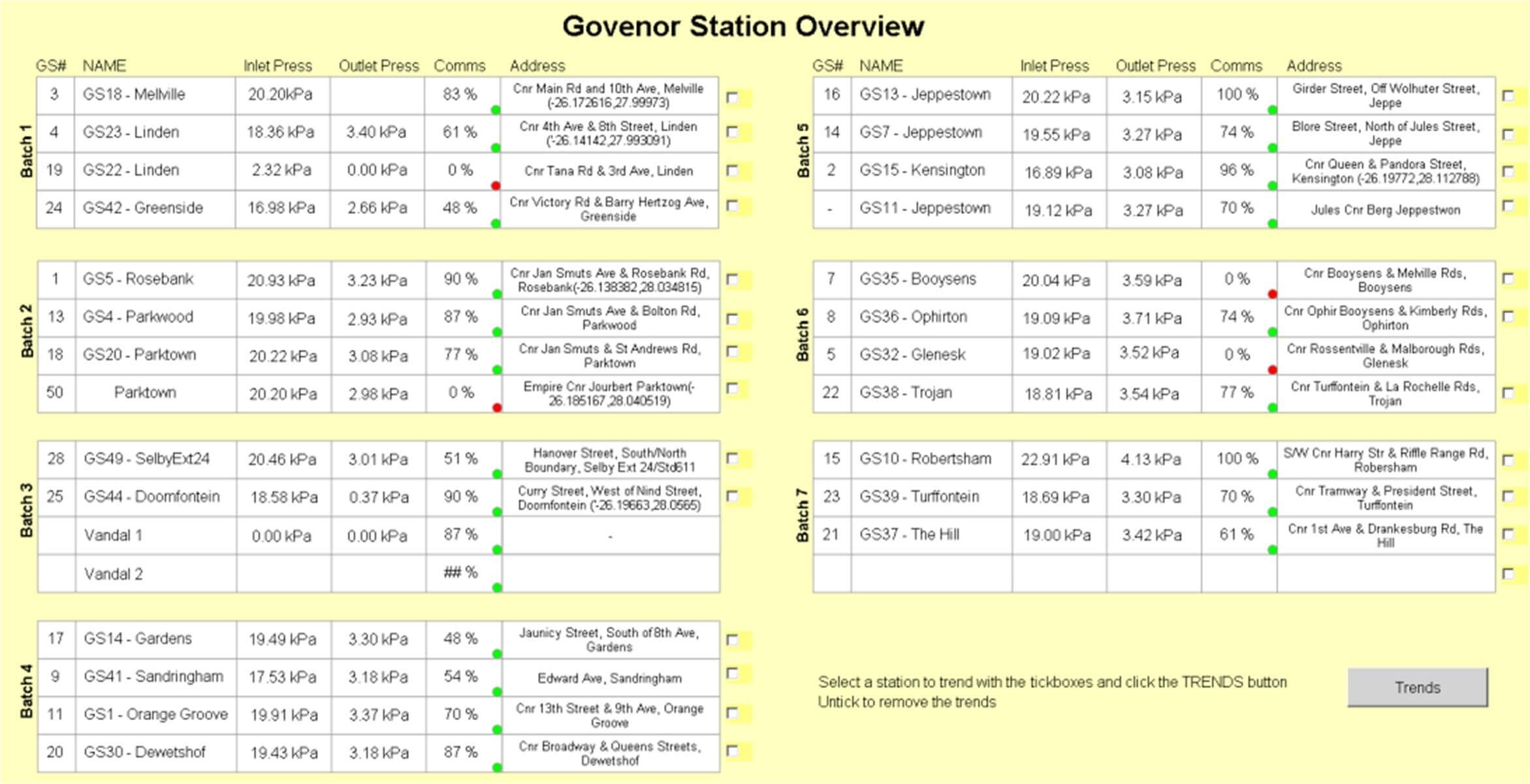
The first glimpse into what’s happening in Egoli Gas’ network is the overview of its 24 governor stations whose job it is to reduce mainline pressure to what consumers need – like a step-down transformer in an electrical network. This InTouch screen provides a concise view of current conditions and alarms. The elimination of all manual data collection lets Egoli Gas personnel concentrate on improving customer service through the early and rapid detection and identification of irregularities in the gas distribution network before they become a problem for end-users. This is especially applicable to those users who use gas for power generation.

“This information also allows us to look after our ageing pipe network to ensure that pressure doesn’t exceed 25 kPa but is maintained above 16 kPa on the high-pressure mains,” says Matodzi. “This level of data acquisition and analysis means that Egoli Gas personnel can focus their experience and expertise on real issues and on maintenance rather than data collection. “

About Egoli Gas (Pty) Ltd
Egoli Gas is a natural gas reticulator based in Johannesburg and servicing more than 7 500 domestic, central water heating, commercial and industrial businesses in the Johannesburg area. The company operates an 1800 km network dating back to the company’s origin in 1892.

The service offers environmentally-friendly, safe, reliable and energy-efficient natural gas. The company’s commitment to their customers’ energy-efficient, low-carbon lifestyle ensures an uninterrupted flow of natural gas ready to use when it’s needed, safely.

Egoli Gas acquires natural gas from Sasol which is stored at a secure facility in Langlaagte where it is carefully monitored and controlled.

The gas is reticulated to Egoli Gas’ Cottesloe premises where it’s stored in low pressure holders before being reticulated to homes and businesses across the city.

For domestic use, Egoli Gas is located in many of the more established Johannesburg suburbs; however, the pipeline extends even further for its commercial and industrial customers.

Success Stories

Food and Beverage

SAB-ABI (AB InBev) Packaging Line Performance

Read the success story below

ASSMANG’s Khumani mine again turns to Iritron and IS³ for its expansion project

ASSMANG’s Khumani iron ore mine is an ambitious undertaking by any definition. Completed in just two years from a foundation of Kalahari sand, Khumani is well on the way to becoming a principal player in the global and competitive world of primary metal production.

Background

ASSMANG’s Khumani iron ore mine is situated in the Northern Cape Province of South Africa and close to Sishen. The Khumani deposits are among the best iron ore resources in the country in terms of quality and quantity. Based on current reserves, a new mine producing 8,4 million tons annually would have a life in excess of 40 years and at double that capacity, a life in excess of about 25 years.

System Integrator Iritron was contracted by DRA Mineral Projects (Pty) Ltd during the initial (2008 greenfields) ASSMANG Khumani project to take responsibility for the implementation of the overall SCADA  (Supervisory, Control and Data Acquisition) system using the AVEVA System Platform (based on ArchestrA Technology) and to integrate into the DRA project C&I team responsible for the systems engineering, instrumentation design,  PLC control system design, network design, implementation and commissioning for the plant.

About ASSMANG

ASSMANG Limited is a South African company that supplies raw material to the world’s steel mills and alloy plants. Most of the group’s production is exported to the Far East, Europe and the USA.

About ASSMANG

Originally named The Associated Manganese Mines of South Africa Limited, the company changed its name to ASSMANG Limited in 2001. ASSMANG, which is owned equally by African Rainbow Minerals and Assore, currently has three operating divisions structured to handle its three commodities of chrome, manganese and iron ore.

Expansion project

For the mine’s expansion Project, ASSMANG again appointed DRA Mineral Projects as the Managing Contractor for the project and Iritron was again contracted by DRA to implement the extensions to the already-installed AVEVA System Platform (formerly Wonderware).

Iritron is a certified AVEVA System Platform integrator and has a long track record with ASSMANG and extensive knowledge of their standards and requirements. To date, Iritron has successfully implemented five large ArchestrA projects ranging from the Northern Cape to the United States and the company is currently busy with another four projects. Iritron is also actively involved in the Beta and systems testing of current and future releases of AVEVA System Platform.

“One of the main advantages of AVEVA System Platform is its scalability, flexibility and ease of expansion once standards and templates have been developed for a specific implementation,” says Iritron director Johann Pienaar. “In this case, the standards and templates that were developed during the initial phase of the project could be re-used for all the new plant sections.”

In terms of hardware, the existing System Platform was expanded by adding an additional pair of redundant Application Object Servers and six additional InTouch View Nodes in the new plant sections – King Primary Crushing, 2nd Load-Out Station and the Jig Plant Extension. No other hardware additions were required – the existing servers and networks had more than sufficient spare capacity in terms of processing power and licensing.

In terms of software development, the effort put in during the definition and development of the standards and templates during the initial project finally paid off. “All that was required was to create new instances of the existing templates (motors, valves, conveyors, crushers, screens, etc.) for each piece of equipment that had to be added,” says Pienaar. “No testing and integration were required, seeing as these templates had already been thoroughly tested. The same applied to the PLC programmes.”

Once the object instances had been created (exports from the FDES instrumentation design software and CSV imports were used to automate this process in both System Platform and in RSLogix5000), the new mimics were created by dragging and dropping the associated object graphics on to the mimic pages and adding the static detail. The graphics and animation form part of the object templates, so no additional configuration or testing was required.

The size of the Khumani Expansion Project is about 50% of the original project, but the SCADA development took less than 10% of the original development thanks to the standards enforcement of the underlying ArchestrA technology. The savings in time will be even more pronounced during commissioning.

“We are thankful for AVEVA’s ArchestrA technology because its developers obviously understood our very real needs and built an environment that allows us to grow painlessly, quickly and to the benefit of our clients,” concludes Pienaar.


Benefits

  • Using standards developed during the initial phase of the project greatly reduced engineering time
  • Thoroughly tested existing templates could be redeployed with confidence
  • The System Platform provided all the necessary scalability, flexibility and ease of expansion the project requiredConclusion
    Proof positive that the bottom line is impacted positively when industrial production solutions “understand” the long-term view rather than cater for the immediate fix. Based on soaring world demand, it’s predictable that Khumani will continue to expand and continue to hone its production processes to maximise profits.Through design, the solutions now in place “understand” that this is the norm of today’s industrial marketplace and will continue to deliver results that keep pace with the inventiveness and ingenuity of their owners. After all is said and done, it’s results that count – not promises.
Success Stories

Mining, Metals and Minerals

Exxaro GMEP

Read the success story below

ASSMANG’s Khumani mine again turns to Iritron and IS³ for its expansion project

ASSMANG’s Khumani iron ore mine is an ambitious undertaking by any definition. Completed in just two years from a foundation of Kalahari sand, Khumani is well on the way to becoming a principal player in the global and competitive world of primary metal production.

Background

ASSMANG’s Khumani iron ore mine is situated in the Northern Cape Province of South Africa and close to Sishen. The Khumani deposits are among the best iron ore resources in the country in terms of quality and quantity. Based on current reserves, a new mine producing 8,4 million tons annually would have a life in excess of 40 years and at double that capacity, a life in excess of about 25 years.

System Integrator Iritron was contracted by DRA Mineral Projects (Pty) Ltd during the initial (2008 greenfields) ASSMANG Khumani project to take responsibility for the implementation of the overall SCADA  (Supervisory, Control and Data Acquisition) system using the AVEVA System Platform (based on ArchestrA Technology) and to integrate into the DRA project C&I team responsible for the systems engineering, instrumentation design,  PLC control system design, network design, implementation and commissioning for the plant.

About ASSMANG

ASSMANG Limited is a South African company that supplies raw material to the world’s steel mills and alloy plants. Most of the group’s production is exported to the Far East, Europe and the USA.

About ASSMANG

Originally named The Associated Manganese Mines of South Africa Limited, the company changed its name to ASSMANG Limited in 2001. ASSMANG, which is owned equally by African Rainbow Minerals and Assore, currently has three operating divisions structured to handle its three commodities of chrome, manganese and iron ore.

“We are planning to produce more than five million tons a year eventually from our mining operations,” says Sechaba Letaba, the senior general manager of BRMO. “As production is ramped up at Nchwaning, the existing surface beneficiation plant was identified as a bottleneck as it did not provide sufficient surface crushing, screening and washing capacity”.

Accordingly system integrator Iritron was appointed as a role player of the EPCM team together with TWP to design, procure and manage the construction of ASSMANG’s Nchwaning III Beneficiation Plant. Alwyn Rautenbach, Group Managing Director of IRITRON, expressed his gratitude to ASSMANG for their continued faith in Iritron to deliver quality EC&I turnkey solutions. He summed up the project by stating that the company had “once again supplied ASSMANG with a quality automation solution that is within budget, on time, easy to maintain and which meets all their operating requirements.”

The new beneficiation plant sources ore from either Nchwaning II or Nchwaning III mines which is placed in one of four ±2500-ton silos depending on the customer/grade required. Via a conveyor system, the ore then goes through a series of crushing, washing and sampling processes and is sized and graded into load-out bins in accordance with various customer requirements. The new beneficiation plant provides for a production changeover from low to high-grade ore in less than twenty minutes.

Iritron tied into the existing 22KV reticulation with two new 22kV distribution stations. The motor control centres (MCCs) were not only designed but also supplied by the Iritron group. The quality up-front design work necessitated very few on-site modifications resulting in a very neat racking and cabling installation where locations are far apart due to the nature of the operations. The instrumentation design was done on Dessoft’s engineering software 1Des and based on remote I/O distribution in the field and cabled to I/O collection points in the MCCs.

Iritron’s brief was to develop an automation solution based on best practices and standards that also cater for future expansion. A leading-edge PLC/SCADA solution was offered that leverages the latest features of Schneider Electric’s Unity Pro v4.0 collaborative engineering software and AVEVA System Platform based on ArchestrA technology, supplied by IS³. The corresponding ArchestrA and Schneider Unity DDT templates were developed for the project and these provide the platform for standardisation, simplified coding and accelerated engineering. AVEVA’s Historian provides the required historical logging, trending and reporting functionality while Information Server web portal allows management and other data clients to view the plant mimics remotely and to keep an eye on continuously-updated production reports. The reports relay real-time and accumulated production throughput and capacity utilisation on a per-shift and daily basis.

At the specific request of Black Rock, Iritron’s Operations Director André Roeloffze, was appointed as the commissioning manager for the new plant on behalf of the mine. The plant was handed over for production in May 2010.