

Success Stories

Mining, Metals and Minerals

Richards Bay Minerals

Read the success story below

Richards Bay Minerals using new AVEVA HMI situational awareness technology

Goals

  • Reduce process safety risk
  • Critical operational information highlighted and operational team empowered
  • Effective management of process control alarms
  • Create awareness of ASM to end-user (production)

Solutions and Products

  • AVEVA System Platform
  • InTouch 2014 (With situational awareness library)
  • Historian 2014
  • Web-enabled Alarm Management
  • ACP ThinManager

Challenges

  • Dealing with change and aspects of human nature
  • Getting acceptance of the solution

Results

  • Mitigation of process safety disasters
  • Improved alarm management
  • Improved abnormal situation management
  • Reduction in cost of operations while maximising business value
  • Standardisation of control systems
  • Improved overall operational effectiveness
  • Improved operator skills and capability
  • Enhanced operational teams’ decision-making process with correct information
 

Background
Actions are based on decisions which are, in turn, based on information. The source of the information is unique and independent of the way it is represented – and that’s where the problems start. How does one display information that is meaningful, required and actionable in real-time all the time?

HMIs are supposed to do just that but the most sophisticated HMI systems can sabotage the bottom line and are potentially deadly if they confuse operators, don’t deliver the level of needed information as and when required and make a mockery of alarms by flooding operators with non-prioritised and unscreened events. Rio Tinto’s Richard Bay Minerals (RBM) cut through complexity and confusion with an effective alarm management solution backed by the latest HMI concept involving situational awareness – this is where pretty pictures leave and serious information takes over.

“As technology improved, the complexity of control systems grew as we made them increasingly sophisticated to improve processes while at the same time introducing the opportunity for errors,” says Kevin Aidan, PCS Superintendent, RBM. “The cure for this was to introduce even more sophistication and automation in a vicious circle. The result is that when things go wrong now, operators have difficulty fixing the problem and so we blame them for the consequences of what has become known as ‘abnormal situations’.

According to Aidan, an abnormal situation is a disturbance or loss of containment with which the control system can no longer cope without intervention. This can have tragic as well as financial consequences including multiple fatalities and personal injuries together with an impact on process safety, equipment damage, product quality, increased production costs and decreased employee job satisfaction through their helplessness to cope with situations beyond their control.

Richards Bay, South Africa

Where Richards Bay Minerals (RBM), a world leader in sand mining and mineral processing operations, produces titania slag, rutile, zircon and high purity iron which all have properties essential to the manufacture of a wide variety of specialised and space-age products. RBM currently has the capacity to produce approximately two million tons of products annually, including approximately 100,000 tons of rutile and 250,000 tons of zircon. At any one time, no fewer than 20 large ocean-going vessels are either at anchorage awaiting loading or on the high seas, transporting RBM’s products to customers across the globe.


HMIs – responsible for more than you might think
On the afternoon of March 23 2005, the BP Texas City refinery in Texas was rocked by a series of explosions when a distillation tower in a hydrocarbon isomerisation unit flooded and sent a geyser of liquid into the air, producing a cloud of highly-flammable vapour that was promptly ignited by an idling pickup truck. Fifteen workers were killed and 180 injured. The blast shattered windows in a 1.2 km radius.

With specific reference to the HMI screens used at the plant, the U.S. Chemical Safety and Hazard Investigation Board (CSB) found that there were no overviews, no trends, inconsistent colours, no condition indications and a flood of alarms. In essence, the CSB declared that the mimic was “essentially just a PID segment sprinkled with live values”. The “fix” included paying about $2B in fines and another billion in complying with findings and regulations.

In January 1992, the crew of an Airbus A320 mistook “Vertical Speed” mode for “Flight Path Angle” mode and the aircraft struck a mountain resulting in the death of 87 of the 96 passengers and crew. Among several items officially cited as causes for the tragedy was the operator interface,

Were these tragedies due to human error or were the operator interfaces partly to blame? Increasingly, ineffective or misleading HMIs are being cited as causes in industrial accidents.


Project requirements
Richards Bay Minerals decided to implement recommendations from both the handbook and from IS³ to address:

  • Finding a resolution to ineffective alarming
  • Improving the display of relevant information
  • Standardisation of graphical symbols
  • Simplifying the operation of systems
  • Improving the effectiveness of operators


Empowering operators to make the right decision at the right time
“These are major topics that can’t be effectively resolved without engaging the people who matter,” says Aidan. “That means establishing interaction requirements for the operators and then designing an effective display where they can visualise what’s happening at a glance – and then repeating the whole process to make sure we’ve got it right.”


Implementation
The pilot project was implemented at a mining pond with the aim of clearly defining KPIs for graphics levels 1-4 and simulating their impact on operators. “Our current level 1 graphic is full of colour and crammed with numbers but far less informative than its new equivalent which, though less colourful, gives a concise view of plant performance and highlights only those KPIs that matter,” says Nkosi Zikalala, PCS Technology and Innovation Specialist, RBM.

All displays are grey and devoid of complexity and confusion showing only the information relevant to the user. In this way, any colour attracts the viewer’s attention and the colour used (red, yellow, magenta, etc.) is a standardised indication of the severity of the anomaly.

During the initial proof-of-concept deployment, a book was left in the control room where operators could log their views and feedback. These are some of the comments received (the added comments are by Kevin Aidan):

  • Confusing mimics – Unfamiliar symbols were bound to create some confusion at first
  • Mimics are too abstract – The operators are familiar with the shapes and forms representing the real-world plant objects
  • Display not bright enough – The development had been done in a completely different environment and lighting condition to the control room
  • No colour – Previously, the presence of colour meant little because of the colourful and realistic displays. Now the mere presence of colour means that operator attention is required and the colour used dictates the degree of that attention
  • Can’t see the burner flame – Operators can see the flickering orange / red flame of the burner– but this isn’t a KPI. The KPI for the burner is a temperature which governs product quality, not the colour of the flame
  • Improved alarm management – Operators previously saw flashing alarms as a distraction and their removal, together with the prioritisation of alarms, were welcome
  • Create our own trends – Operators can now create their own trends depending on their changing requirements

“The feedback from the senior leadership team was positive as they approved the implementation plan while the CEO of Rio Tinto Iron and Titanium wanted to know what was required to move the implementation plan forward,” says Aidan.


Conclusion
HMIs are the primary interface operators have with the processes in their charge. These displays are in constant use and changing them is bound to meet with some resistance and that’s why operators should be involved at every step of the migration to situational awareness HMIs as well as in the FAT. “To change behaviour, it first has to be motivated and then entrenched with habit,” says Aidan.

On the other hand, this initial resistance to change is offset by faster and easier determination of the current process situation, relevant rather than distracting alarms, uncluttered displays and a focus on the information that matters rather than impressive graphics or “essentially just a PID segment sprinkled with live values”.

“This is the first step in an information management process which must move up from the SCADA / HMI level to MIS, MES and beyond,” concludes Aidan.


Benefits

  • Mitigation of process safety disasters.
  • Improved alarm management
  • Improved abnormal situation management
  • Reduction in cost of operations while maximising business value
  • Standardisation of control systems
  • Improved overall operational effectiveness
  • Improved operator skills and capability
  • Enhanced operational team’s decision making process with correct information

Success Stories

Mining, Metals and Minerals

Richards Bay Minerals

Read the success story below

Richards Bay Minerals using new AVEVA HMI situational awareness technology

Goals

  • Reduce process safety risk
  • Critical operational information highlighted and operational team empowered
  • Effective management of process control alarms
  • Create awareness of ASM to end-user (production)

Solutions and Products

  • AVEVA System Platform
  • InTouch 2014 (With situational awareness library)
  • Historian 2014
  • Web-enabled Alarm Management
  • ACP ThinManager

Challenges

  • Dealing with change and aspects of human nature
  • Getting acceptance of the solution

Results

  • Mitigation of process safety disasters
  • Improved alarm management
  • Improved abnormal situation management
  • Reduction in cost of operations while maximising business value
  • Standardisation of control systems
  • Improved overall operational effectiveness
  • Improved operator skills and capability
  • Enhanced operational teams’ decision-making process with correct information
 

Background
Actions are based on decisions which are, in turn, based on information. The source of the information is unique and independent of the way it is represented – and that’s where the problems start. How does one display information that is meaningful, required and actionable in real-time all the time?

HMIs are supposed to do just that but the most sophisticated HMI systems can sabotage the bottom line and are potentially deadly if they confuse operators, don’t deliver the level of needed information as and when required and make a mockery of alarms by flooding operators with non-prioritised and unscreened events. Rio Tinto’s Richard Bay Minerals (RBM) cut through complexity and confusion with an effective alarm management solution backed by the latest HMI concept involving situational awareness – this is where pretty pictures leave and serious information takes over.

“As technology improved, the complexity of control systems grew as we made them increasingly sophisticated to improve processes while at the same time introducing the opportunity for errors,” says Kevin Aidan, PCS Superintendent, RBM. “The cure for this was to introduce even more sophistication and automation in a vicious circle. The result is that when things go wrong now, operators have difficulty fixing the problem and so we blame them for the consequences of what has become known as ‘abnormal situations’.

According to Aidan, an abnormal situation is a disturbance or loss of containment with which the control system can no longer cope without intervention. This can have tragic as well as financial consequences including multiple fatalities and personal injuries together with an impact on process safety, equipment damage, product quality, increased production costs and decreased employee job satisfaction through their helplessness to cope with situations beyond their control.

Richards Bay, South Africa

Where Richards Bay Minerals (RBM), a world leader in sand mining and mineral processing operations, produces titania slag, rutile, zircon and high purity iron which all have properties essential to the manufacture of a wide variety of specialised and space-age products. RBM currently has the capacity to produce approximately two million tons of products annually, including approximately 100,000 tons of rutile and 250,000 tons of zircon. At any one time, no fewer than 20 large ocean-going vessels are either at anchorage awaiting loading or on the high seas, transporting RBM’s products to customers across the globe.


HMIs – responsible for more than you might think
On the afternoon of March 23 2005, the BP Texas City refinery in Texas was rocked by a series of explosions when a distillation tower in a hydrocarbon isomerisation unit flooded and sent a geyser of liquid into the air, producing a cloud of highly-flammable vapour that was promptly ignited by an idling pickup truck. Fifteen workers were killed and 180 injured. The blast shattered windows in a 1.2 km radius.

With specific reference to the HMI screens used at the plant, the U.S. Chemical Safety and Hazard Investigation Board (CSB) found that there were no overviews, no trends, inconsistent colours, no condition indications and a flood of alarms. In essence, the CSB declared that the mimic was “essentially just a PID segment sprinkled with live values”. The “fix” included paying about $2B in fines and another billion in complying with findings and regulations.

In January 1992, the crew of an Airbus A320 mistook “Vertical Speed” mode for “Flight Path Angle” mode and the aircraft struck a mountain resulting in the death of 87 of the 96 passengers and crew. Among several items officially cited as causes for the tragedy was the operator interface,

Were these tragedies due to human error or were the operator interfaces partly to blame? Increasingly, ineffective or misleading HMIs are being cited as causes in industrial accidents.


Project requirements
Richards Bay Minerals decided to implement recommendations from both the handbook and from IS³ to address:

  • Finding a resolution to ineffective alarming
  • Improving the display of relevant information
  • Standardisation of graphical symbols
  • Simplifying the operation of systems
  • Improving the effectiveness of operators


Empowering operators to make the right decision at the right time
“These are major topics that can’t be effectively resolved without engaging the people who matter,” says Aidan. “That means establishing interaction requirements for the operators and then designing an effective display where they can visualise what’s happening at a glance – and then repeating the whole process to make sure we’ve got it right.”


Implementation
The pilot project was implemented at a mining pond with the aim of clearly defining KPIs for graphics levels 1-4 and simulating their impact on operators. “Our current level 1 graphic is full of colour and crammed with numbers but far less informative than its new equivalent which, though less colourful, gives a concise view of plant performance and highlights only those KPIs that matter,” says Nkosi Zikalala, PCS Technology and Innovation Specialist, RBM.

All displays are grey and devoid of complexity and confusion showing only the information relevant to the user. In this way, any colour attracts the viewer’s attention and the colour used (red, yellow, magenta, etc.) is a standardised indication of the severity of the anomaly.

During the initial proof-of-concept deployment, a book was left in the control room where operators could log their views and feedback. These are some of the comments received (the added comments are by Kevin Aidan):

  • Confusing mimics – Unfamiliar symbols were bound to create some confusion at first
  • Mimics are too abstract – The operators are familiar with the shapes and forms representing the real-world plant objects
  • Display not bright enough – The development had been done in a completely different environment and lighting condition to the control room
  • No colour – Previously, the presence of colour meant little because of the colourful and realistic displays. Now the mere presence of colour means that operator attention is required and the colour used dictates the degree of that attention
  • Can’t see the burner flame – Operators can see the flickering orange / red flame of the burner– but this isn’t a KPI. The KPI for the burner is a temperature which governs product quality, not the colour of the flame
  • Improved alarm management – Operators previously saw flashing alarms as a distraction and their removal, together with the prioritisation of alarms, were welcome
  • Create our own trends – Operators can now create their own trends depending on their changing requirements

“The feedback from the senior leadership team was positive as they approved the implementation plan while the CEO of Rio Tinto Iron and Titanium wanted to know what was required to move the implementation plan forward,” says Aidan.


Conclusion
HMIs are the primary interface operators have with the processes in their charge. These displays are in constant use and changing them is bound to meet with some resistance and that’s why operators should be involved at every step of the migration to situational awareness HMIs as well as in the FAT. “To change behaviour, it first has to be motivated and then entrenched with habit,” says Aidan.

On the other hand, this initial resistance to change is offset by faster and easier determination of the current process situation, relevant rather than distracting alarms, uncluttered displays and a focus on the information that matters rather than impressive graphics or “essentially just a PID segment sprinkled with live values”.

“This is the first step in an information management process which must move up from the SCADA / HMI level to MIS, MES and beyond,” concludes Aidan.


Benefits

  • Mitigation of process safety disasters.
  • Improved alarm management
  • Improved abnormal situation management
  • Reduction in cost of operations while maximising business value
  • Standardisation of control systems
  • Improved overall operational effectiveness
  • Improved operator skills and capability
  • Enhanced operational team’s decision making process with correct information
About ASSMANG

ASSMANG Limited is a South African company that supplies raw material to the world’s steel mills and alloy plants. Most of the group’s production is exported to the Far East, Europe and the USA.

About ASSMANG

Originally named The Associated Manganese Mines of South Africa Limited, the company changed its name to ASSMANG Limited in 2001. ASSMANG, which is owned equally by African Rainbow Minerals and Assore, currently has three operating divisions structured to handle its three commodities of chrome, manganese and iron ore.

The Khumani mine project was to be implemented in two phases:

  • Phase 1 was to be completed in September 2008 and would have a capacity of 8.4 million tons of iron ore per year. Phase 1a, to be completed in December 2008, would have a capacity of 10 million tons per year.
  • Phase 2 will have an annual production level of 16 million tons and is scheduled for completion in late 2010 / early 2011.
  • A possible further expansion to 22 million tons per annum is presently at the feasibility study stage.

The iron ore is mined from a series of open pits by conventional drilling and blasting before being loaded onto trucks for hauling to the primary and secondary crushers. From there, the ore is transferred by conveyor to stockpiles ahead of the beneficiation plant. The run-of-mine ore is stockpiled on blending beds in two categories, ‘on-grade’ and ‘off-grade’.

The on-grade ore is crushed, washed and graded according to four size categories. The off-grade ore goes through an identical crushing, washing and screening process, followed by a jig beneficiation plant to match its chemical composition with client specifications.

There are 8 Geoscan on-line analysers installed at critical locations in the plant to monitor the chemical composition of the ore in real-time, so that immediate remedial action can be taken if the ore deviates from the chemical grade requirements.

Products are stockpiled ahead of a rapid load-out station, which has the capability to load 342 x 100-ton wagons in 8 hours – that’s one 100-ton wagon every 90 seconds. From there, the product is railed 860 kms to the port of Saldanha Bay for export.


Solution selection
DRA Mineral Projects were appointed as the Managing contractor for this project and EPCM contractor for the plant and infrastructure. DRA Mineral Projects is an engineering company that specialises in project management, engineering design and implementation and has implemented successful projects on five continents. DRA appointed system integrator Iritron for the ArchestrA System Platform 3.0 implementation portion of the project. Iritron was actively involved in the systems engineering, instrumentation design and PLC control systems aspects of the scheme.

This was a natural choice since African Rainbow Minerals and ASSMANG have standardised on AVEVA (formerly Wonderware) industrial automation solutions for all their SCADA, Historian and plant web portal requirements, and Iritron is an ArchestrA-certified system integrator that has provided AVEVA solutions and support to ASSMANG since 1999.

“To effectively monitor this huge complex, we implemented AVEVA System Platform which is based on ArchestrA technology and includes real-time Historian, the Information Server web portal, ActiveFactory real-time production performance analysis and reporting software and InTouch for the SCADA/HMI applications serving some 44 000 I/O tags,” says Iritron director Johann Pienaar. “In addition, we used the Topserver I/O Servers from Software Toolbox to communicate between the PLCs and the System Platform as well as MDT Software’s AutoSave for the change control management of all 63 Allen-Bradley ControlLogix PLCs.”

“These solutions were chosen to give us comprehensive data analysis facilities so that we could check production status and identify potential problems at any time, “ says Marius Malan, control systems supervisor, ASSMANG. “We also need continuous operation without loss of control or data as well as web access facilities and links to our planning and ERP systems. Most importantly, it all has to work through a user-friendly and intuitive operator interface.

“But these are all things we need to do now. This is a brand-new mine with a long future and we will need to adapt production to meet with market demands. That means we’ll have to expand the system as and when required and we’ll also have to do it quickly and at minimal cost.”


System implementation
Allowing for the expansion of systems at minimal cost is a cornerstone of ArchestrA technology and one of the ways this happens is through the development of standards.

Standards allow companies to define, apply and enforce their engineering criteria so that everyone works from the same page. Standards also mean that plant objects are built from templates and that changes to a single master template can be propagated to every instance of that object throughout the plant.

“The standards enforced by ArchestrA are allowing us to describe plant objects and their behaviour to reflect our experience and needs,” says Malan. “Being ASSMANG standards, they reflect our best practices and can be used by other companies in the group. The enforcement of standards ensures that all future development conforms to the norms already developed and this will save engineering time in the future, especially with the planned extensions to the plant.”

Standards don’t only apply to plant objects but also to the whole plant and to integration with other disciplines in the company. One of the key standards that helps businesses build a coherent organisation is ISA-95.

“Khumani’s plant model is based on the ISA-95 standard which was facilitated by AVEVA’s System Platform Application Server and its best practices guide supplied by IS³,” adds Pienaar. “This standard was implemented and adhered to throughout the project and will greatly facilitate integrating the system’s information with ASSMANG’s planning and ERP systems.”

Another important ArchestrA attribute that safeguards expansion at minimal cost is that of scalability. At Khumani, they know they will have to double their capacity in two years and, in ordinary conditions, this could mean some expensive system rework.

“When the time comes to expand the system, the initial work done on standards means that defining new capability will be a matter of hours rather than weeks or months,” says Pienaar. “In addition, ArchestrA has been proved to handle more than a million I/O tags and we’re currently looking at (only) about 44 000. This, together with a self-configuring historian, makes system expansion painless.”

ASSMANG’s Khumani mine, a major contributor to the company’s financial well-being, can’t afford unplanned production delays during its lengthy and productive life. The mine has to produce quality products that will be accepted worldwide in an extremely competitive market and to do that, it needs industrial information and automation equipment equal to the task.

“ArchestrA’s management of dual redundancy procedures not only guarantees delivery of data to the Historian but has saved us a significant amount of complex software engineering to resolve this critical issue, says Malan. “In fact, we no longer think “redundancy” but rather of decisions that have to be made given the wealth of available information – in other words, forget the technology and focus on the business.”

Apart from standards, scalability and system availability, ASSMANG needs a few more key attributes from a system in charge of one of its primary wealth-creating facilities and these are security and architectural freedom – which don’t mean much if said quickly but are key to versatility and freedom of choice.

“In a situation such as ours, it’s important that only authorised personnel has access to various levels of the system to make changes to set points and other parameters,” says Malan. With the System Platform, security and alarming are uniform across the entire system and we don’t have to make provision for discrete sub-systems. Of equal importance is our ability to change our mind with respect to the structure of our system and its interaction with others. ArchestrA technology gives us that choice. For example, we had to integrate with a number of third party stand-alone InTouch applications incorporated into the Metso crushers, the Bateman load-out station, a QMastor stockpile management system and a CCLAS LIMS system. Well, it all just ‘happened’”.


Conclusion
“For us, the most significant aspect of this project was that ArchestrA technology gave us a multi-user development environment that allowed us to design, develop, implement and maintain a large project in one year,” says Pienaar. “ArchestrA’s integrated development environment gave us the tools to develop complex applications without bothering unnecessarily about the details of interfacing with PLCs at one end of the spectrum and ERP systems at the other while providing the functionality to do both.”

From the start, ASSMANG’s Khumani mine is a winner, not only in terms of its rich deposits but also in terms of how it will process them. Today, no enterprise can survive without efficiency and a major contributor is how well processes can be measured and controlled. AVEVA’s System Platform will be providing Khumani mine’s managers and operators the plant intelligence they need for efficient operation far into the future.

Exxaro Coal (Pty) Ltd

Read the Success Success Story below

Richards Bay Minerals using new AVEVA HMI situational awareness technology

Goals

  • Reduce process safety risk
  • Critical operational information highlighted and operational team empowered
  • Effective management of process control alarms
  • Create awareness of ASM to end-user (production)

Solutions and Products

  • AVEVA System Platform
  • InTouch 2014 (With situational awareness library)
  • Historian 2014
  • Web-enabled Alarm Management
  • ACP ThinManager

Challenges

  • Dealing with change and aspects of human nature
  • Getting acceptance of the solution

Results

  • Mitigation of process safety disasters
  • Improved alarm management
  • Improved abnormal situation management
  • Reduction in cost of operations while maximising business value
  • Standardisation of control systems
  • Improved overall operational effectiveness
  • Improved operator skills and capability
  • Enhanced operational teams’ decision-making process with correct information

 

Background
Actions are based on decisions which are, in turn, based on information. The source of the information is unique and independent of the way it is represented – and that’s where the problems start. How does one display information that is meaningful, required and actionable in real-time all the time?

HMIs are supposed to do just that but the most sophisticated HMI systems can sabotage the bottom line and are potentially deadly if they confuse operators, don’t deliver the level of needed information as and when required and make a mockery of alarms by flooding operators with non-prioritised and unscreened events. Rio Tinto’s Richard Bay Minerals (RBM) cut through complexity and confusion with an effective alarm management solution backed by the latest HMI concept involving situational awareness – this is where pretty pictures leave and serious information takes over.

“As technology improved, the complexity of control systems grew as we made them increasingly sophisticated to improve processes while at the same time introducing the opportunity for errors,” says Kevin Aidan, PCS Superintendent, RBM. “The cure for this was to introduce even more sophistication and automation in a vicious circle. The result is that when things go wrong now, operators have difficulty fixing the problem and so we blame them for the consequences of what has become known as ‘abnormal situations’.

According to Aidan, an abnormal situation is a disturbance or loss of containment with which the control system can no longer cope without intervention. This can have tragic as well as financial consequences including multiple fatalities and personal injuries together with an impact on process safety, equipment damage, product quality, increased production costs and decreased employee job satisfaction through their helplessness to cope with situations beyond their control.

Richards Bay, South Africa

Where Richards Bay Minerals (RBM), a world leader in sand mining and mineral processing operations, produces titania slag, rutile, zircon and high purity iron which all have properties essential to the manufacture of a wide variety of specialised and space-age products. RBM currently has the capacity to produce approximately two million tons of products annually, including approximately 100,000 tons of rutile and 250,000 tons of zircon. At any one time, no fewer than 20 large ocean-going vessels are either at anchorage awaiting loading or on the high seas, transporting RBM’s products to customers across the globe.


HMIs – responsible for more than you might think
On the afternoon of March 23 2005, the BP Texas City refinery in Texas was rocked by a series of explosions when a distillation tower in a hydrocarbon isomerisation unit flooded and sent a geyser of liquid into the air, producing a cloud of highly-flammable vapour that was promptly ignited by an idling pickup truck. Fifteen workers were killed and 180 injured. The blast shattered windows in a 1.2 km radius.

With specific reference to the HMI screens used at the plant, the U.S. Chemical Safety and Hazard Investigation Board (CSB) found that there were no overviews, no trends, inconsistent colours, no condition indications and a flood of alarms. In essence, the CSB declared that the mimic was “essentially just a PID segment sprinkled with live values”. The “fix” included paying about $2B in fines and another billion in complying with findings and regulations.

In January 1992, the crew of an Airbus A320 mistook “Vertical Speed” mode for “Flight Path Angle” mode and the aircraft struck a mountain resulting in the death of 87 of the 96 passengers and crew. Among several items officially cited as causes for the tragedy was the operator interface,

Were these tragedies due to human error or were the operator interfaces partly to blame? Increasingly, ineffective or misleading HMIs are being cited as causes in industrial accidents.


Project requirements
Richards Bay Minerals decided to implement recommendations from both the handbook and from IS³ to address:

  • Finding a resolution to ineffective alarming
  • Improving the display of relevant information
  • Standardisation of graphical symbols
  • Simplifying the operation of systems
  • Improving the effectiveness of operators


Empowering operators to make the right decision at the right time
“These are major topics that can’t be effectively resolved without engaging the people who matter,” says Aidan. “That means establishing interaction requirements for the operators and then designing an effective display where they can visualise what’s happening at a glance – and then repeating the whole process to make sure we’ve got it right.”


Implementation
The pilot project was implemented at a mining pond with the aim of clearly defining KPIs for graphics levels 1-4 and simulating their impact on operators. “Our current level 1 graphic is full of colour and crammed with numbers but far less informative than its new equivalent which, though less colourful, gives a concise view of plant performance and highlights only those KPIs that matter,” says Nkosi Zikalala, PCS Technology and Innovation Specialist, RBM.

All displays are grey and devoid of complexity and confusion showing only the information relevant to the user. In this way, any colour attracts the viewer’s attention and the colour used (red, yellow, magenta, etc.) is a standardised indication of the severity of the anomaly.

During the initial proof-of-concept deployment, a book was left in the control room where operators could log their views and feedback. These are some of the comments received (the added comments are by Kevin Aidan):

  • Confusing mimics – Unfamiliar symbols were bound to create some confusion at first
  • Mimics are too abstract – The operators are familiar with the shapes and forms representing the real-world plant objects
  • Display not bright enough – The development had been done in a completely different environment and lighting condition to the control room
  • No colour – Previously, the presence of colour meant little because of the colourful and realistic displays. Now the mere presence of colour means that operator attention is required and the colour used dictates the degree of that attention
  • Can’t see the burner flame – Operators can see the flickering orange / red flame of the burner– but this isn’t a KPI. The KPI for the burner is a temperature which governs product quality, not the colour of the flame
  • Improved alarm management – Operators previously saw flashing alarms as a distraction and their removal, together with the prioritisation of alarms, were welcome
  • Create our own trends – Operators can now create their own trends depending on their changing requirements

“The feedback from the senior leadership team was positive as they approved the implementation plan while the CEO of Rio Tinto Iron and Titanium wanted to know what was required to move the implementation plan forward,” says Aidan.


Conclusion
HMIs are the primary interface operators have with the processes in their charge. These displays are in constant use and changing them is bound to meet with some resistance and that’s why operators should be involved at every step of the migration to situational awareness HMIs as well as in the FAT. “To change behaviour, it first has to be motivated and then entrenched with habit,” says Aidan.

On the other hand, this initial resistance to change is offset by faster and easier determination of the current process situation, relevant rather than distracting alarms, uncluttered displays and a focus on the information that matters rather than impressive graphics or “essentially just a PID segment sprinkled with live values”.

“This is the first step in an information management process which must move up from the SCADA / HMI level to MIS, MES and beyond,” concludes Aidan.


Benefits

  • Mitigation of process safety disasters.
  • Improved alarm management
  • Improved abnormal situation management
  • Reduction in cost of operations while maximising business value
  • Standardisation of control systems
  • Improved overall operational effectiveness
  • Improved operator skills and capability
  • Enhanced operational team’s decision making process with correct information
All future projects involving systems providing information will be structured by using this information modelling tool. Implementation will then follow according to the approved information model. Exxaro Grootegeluk management is excited about the value that can be added to the business with this new tool.”

Almero Roux, Solution Architect, MES & Plant, Exxaro

About ASSMANG

ASSMANG Limited is a South African company that supplies raw material to the world’s steel mills and alloy plants. Most of the group’s production is exported to the Far East, Europe and the USA.

About ASSMANG

Originally named The Associated Manganese Mines of South Africa Limited, the company changed its name to ASSMANG Limited in 2001. ASSMANG, which is owned equally by African Rainbow Minerals and Assore, currently has three operating divisions structured to handle its three commodities of chrome, manganese and iron ore.

The Khumani mine project was to be implemented in two phases:

  • Phase 1 was to be completed in September 2008 and would have a capacity of 8.4 million tons of iron ore per year. Phase 1a, to be completed in December 2008, would have a capacity of 10 million tons per year.
  • Phase 2 will have an annual production level of 16 million tons and is scheduled for completion in late 2010 / early 2011.
  • A possible further expansion to 22 million tons per annum is presently at the feasibility study stage.

The iron ore is mined from a series of open pits by conventional drilling and blasting before being loaded onto trucks for hauling to the primary and secondary crushers. From there, the ore is transferred by conveyor to stockpiles ahead of the beneficiation plant. The run-of-mine ore is stockpiled on blending beds in two categories, ‘on-grade’ and ‘off-grade’.

The on-grade ore is crushed, washed and graded according to four size categories. The off-grade ore goes through an identical crushing, washing and screening process, followed by a jig beneficiation plant to match its chemical composition with client specifications.

There are 8 Geoscan on-line analysers installed at critical locations in the plant to monitor the chemical composition of the ore in real-time, so that immediate remedial action can be taken if the ore deviates from the chemical grade requirements.

Products are stockpiled ahead of a rapid load-out station, which has the capability to load 342 x 100-ton wagons in 8 hours – that’s one 100-ton wagon every 90 seconds. From there, the product is railed 860 kms to the port of Saldanha Bay for export.


Solution selection
DRA Mineral Projects were appointed as the Managing contractor for this project and EPCM contractor for the plant and infrastructure. DRA Mineral Projects is an engineering company that specialises in project management, engineering design and implementation and has implemented successful projects on five continents. DRA appointed system integrator Iritron for the ArchestrA System Platform 3.0 implementation portion of the project. Iritron was actively involved in the systems engineering, instrumentation design and PLC control systems aspects of the scheme.

This was a natural choice since African Rainbow Minerals and ASSMANG have standardised on AVEVA (formerly Wonderware) industrial automation solutions for all their SCADA, Historian and plant web portal requirements, and Iritron is an ArchestrA-certified system integrator that has provided AVEVA solutions and support to ASSMANG since 1999.

“To effectively monitor this huge complex, we implemented AVEVA System Platform which is based on ArchestrA technology and includes real-time Historian, the Information Server web portal, ActiveFactory real-time production performance analysis and reporting software and InTouch for the SCADA/HMI applications serving some 44 000 I/O tags,” says Iritron director Johann Pienaar. “In addition, we used the Topserver I/O Servers from Software Toolbox to communicate between the PLCs and the System Platform as well as MDT Software’s AutoSave for the change control management of all 63 Allen-Bradley ControlLogix PLCs.”

“These solutions were chosen to give us comprehensive data analysis facilities so that we could check production status and identify potential problems at any time, “ says Marius Malan, control systems supervisor, ASSMANG. “We also need continuous operation without loss of control or data as well as web access facilities and links to our planning and ERP systems. Most importantly, it all has to work through a user-friendly and intuitive operator interface.

“But these are all things we need to do now. This is a brand-new mine with a long future and we will need to adapt production to meet with market demands. That means we’ll have to expand the system as and when required and we’ll also have to do it quickly and at minimal cost.”


System implementation
Allowing for the expansion of systems at minimal cost is a cornerstone of ArchestrA technology and one of the ways this happens is through the development of standards.

Standards allow companies to define, apply and enforce their engineering criteria so that everyone works from the same page. Standards also mean that plant objects are built from templates and that changes to a single master template can be propagated to every instance of that object throughout the plant.

“The standards enforced by ArchestrA are allowing us to describe plant objects and their behaviour to reflect our experience and needs,” says Malan. “Being ASSMANG standards, they reflect our best practices and can be used by other companies in the group. The enforcement of standards ensures that all future development conforms to the norms already developed and this will save engineering time in the future, especially with the planned extensions to the plant.”

Standards don’t only apply to plant objects but also to the whole plant and to integration with other disciplines in the company. One of the key standards that helps businesses build a coherent organisation is ISA-95.

“Khumani’s plant model is based on the ISA-95 standard which was facilitated by AVEVA’s System Platform Application Server and its best practices guide supplied by IS³,” adds Pienaar. “This standard was implemented and adhered to throughout the project and will greatly facilitate integrating the system’s information with ASSMANG’s planning and ERP systems.”

Another important ArchestrA attribute that safeguards expansion at minimal cost is that of scalability. At Khumani, they know they will have to double their capacity in two years and, in ordinary conditions, this could mean some expensive system rework.

“When the time comes to expand the system, the initial work done on standards means that defining new capability will be a matter of hours rather than weeks or months,” says Pienaar. “In addition, ArchestrA has been proved to handle more than a million I/O tags and we’re currently looking at (only) about 44 000. This, together with a self-configuring historian, makes system expansion painless.”

ASSMANG’s Khumani mine, a major contributor to the company’s financial well-being, can’t afford unplanned production delays during its lengthy and productive life. The mine has to produce quality products that will be accepted worldwide in an extremely competitive market and to do that, it needs industrial information and automation equipment equal to the task.

“ArchestrA’s management of dual redundancy procedures not only guarantees delivery of data to the Historian but has saved us a significant amount of complex software engineering to resolve this critical issue, says Malan. “In fact, we no longer think “redundancy” but rather of decisions that have to be made given the wealth of available information – in other words, forget the technology and focus on the business.”

Apart from standards, scalability and system availability, ASSMANG needs a few more key attributes from a system in charge of one of its primary wealth-creating facilities and these are security and architectural freedom – which don’t mean much if said quickly but are key to versatility and freedom of choice.

“In a situation such as ours, it’s important that only authorised personnel has access to various levels of the system to make changes to set points and other parameters,” says Malan. With the System Platform, security and alarming are uniform across the entire system and we don’t have to make provision for discrete sub-systems. Of equal importance is our ability to change our mind with respect to the structure of our system and its interaction with others. ArchestrA technology gives us that choice. For example, we had to integrate with a number of third party stand-alone InTouch applications incorporated into the Metso crushers, the Bateman load-out station, a QMastor stockpile management system and a CCLAS LIMS system. Well, it all just ‘happened’”.


Conclusion
“For us, the most significant aspect of this project was that ArchestrA technology gave us a multi-user development environment that allowed us to design, develop, implement and maintain a large project in one year,” says Pienaar. “ArchestrA’s integrated development environment gave us the tools to develop complex applications without bothering unnecessarily about the details of interfacing with PLCs at one end of the spectrum and ERP systems at the other while providing the functionality to do both.”

From the start, ASSMANG’s Khumani mine is a winner, not only in terms of its rich deposits but also in terms of how it will process them. Today, no enterprise can survive without efficiency and a major contributor is how well processes can be measured and controlled. AVEVA’s System Platform will be providing Khumani mine’s managers and operators the plant intelligence they need for efficient operation far into the future.

Implementation

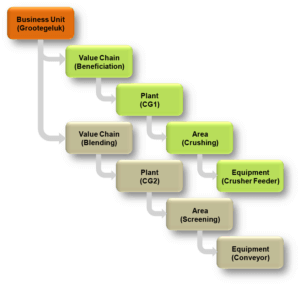
Exxaro has standardised on AVEVA System Platform (formerly Wonderware) as their operational technology and they preferred to use the toolset provided by IS³ to ensure an off-the-shelf technology for the information modelling tool. Also, the concept of instantiation of predefined templates suited the hierarchical requirements of the information model.

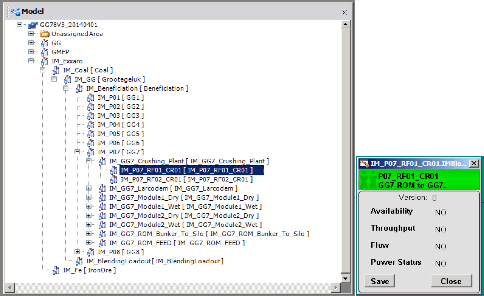
Exxaro selected Control Systems Integration (CSI) for the implementation of the project. “Prior to this project, no information modelling tool existed at the mine,” says CSI director Dries van Schalkwyk. “We used the standard off-the-shelf ArchestrA scripting environment to develop the object templates, providing a standard and open system which is easy to configure and maintain. The information modelling objects were developed in line with the S95/S88 conventions. This tool was then used to generate the configuration and availability rules for AVEVA MES Performance. We also used InTouch as the human-machine interface for the information modelling tool.”

ArchestrA-based System Platform provided CSI with the flexibility to build object model templates that could be used to define the information model and its properties to meet Exxaro’s specific needs. In addition, the system’s version control and flexibility allowed the generation of objects that enforced compliance with the best practices as well as standardisation of the methodology and business process required to define the information model.

“The object-oriented nature of ArchestrA and its template development facilities enabled us to develop flexible objects that could be reused through instantiation, thereby saving time and cost in engineering and maintenance,” says van Schalkwyk.

With every new version of an information block, an XML file is created. This allows the redeployment of the objects without dropping any information. The XML file can then be imported into an Excel template for printing which makes the approval process a lot easier.

Benefits

  • Reduced engineering cost
  • Reduced paperwork
  • Traceability and version control of information
  • Automatic documentation of the information model, rules and requirements,
  • Easier and shorter implementation of the business process
  • Reduction in the schedule for business rule definition and approval
  • Easier formulation of rules for the control system
  • Automatic collation of needed information
  • Ease of maintenance
  • Uniform naming standard
  • Empowered end user
Success Stories

Mining, Metals and Minerals

Hulamin Limited

Read the success story below

Richards Bay Minerals using new AVEVA HMI situational awareness technology

Goals

  • Reduce process safety risk
  • Critical operational information highlighted and operational team empowered
  • Effective management of process control alarms
  • Create awareness of ASM to end-user (production)

Solutions and Products

  • AVEVA System Platform
  • InTouch 2014 (With situational awareness library)
  • Historian 2014
  • Web-enabled Alarm Management
  • ACP ThinManager

Challenges

  • Dealing with change and aspects of human nature
  • Getting acceptance of the solution

Results

  • Mitigation of process safety disasters
  • Improved alarm management
  • Improved abnormal situation management
  • Reduction in cost of operations while maximising business value
  • Standardisation of control systems
  • Improved overall operational effectiveness
  • Improved operator skills and capability
  • Enhanced operational teams’ decision-making process with correct information

 

Background
Actions are based on decisions which are, in turn, based on information. The source of the information is unique and independent of the way it is represented – and that’s where the problems start. How does one display information that is meaningful, required and actionable in real-time all the time?

HMIs are supposed to do just that but the most sophisticated HMI systems can sabotage the bottom line and are potentially deadly if they confuse operators, don’t deliver the level of needed information as and when required and make a mockery of alarms by flooding operators with non-prioritised and unscreened events. Rio Tinto’s Richard Bay Minerals (RBM) cut through complexity and confusion with an effective alarm management solution backed by the latest HMI concept involving situational awareness – this is where pretty pictures leave and serious information takes over.

“As technology improved, the complexity of control systems grew as we made them increasingly sophisticated to improve processes while at the same time introducing the opportunity for errors,” says Kevin Aidan, PCS Superintendent, RBM. “The cure for this was to introduce even more sophistication and automation in a vicious circle. The result is that when things go wrong now, operators have difficulty fixing the problem and so we blame them for the consequences of what has become known as ‘abnormal situations’.

According to Aidan, an abnormal situation is a disturbance or loss of containment with which the control system can no longer cope without intervention. This can have tragic as well as financial consequences including multiple fatalities and personal injuries together with an impact on process safety, equipment damage, product quality, increased production costs and decreased employee job satisfaction through their helplessness to cope with situations beyond their control.

Richards Bay, South Africa

Where Richards Bay Minerals (RBM), a world leader in sand mining and mineral processing operations, produces titania slag, rutile, zircon and high purity iron which all have properties essential to the manufacture of a wide variety of specialised and space-age products. RBM currently has the capacity to produce approximately two million tons of products annually, including approximately 100,000 tons of rutile and 250,000 tons of zircon. At any one time, no fewer than 20 large ocean-going vessels are either at anchorage awaiting loading or on the high seas, transporting RBM’s products to customers across the globe.


HMIs – responsible for more than you might think
On the afternoon of March 23 2005, the BP Texas City refinery in Texas was rocked by a series of explosions when a distillation tower in a hydrocarbon isomerisation unit flooded and sent a geyser of liquid into the air, producing a cloud of highly-flammable vapour that was promptly ignited by an idling pickup truck. Fifteen workers were killed and 180 injured. The blast shattered windows in a 1.2 km radius.

With specific reference to the HMI screens used at the plant, the U.S. Chemical Safety and Hazard Investigation Board (CSB) found that there were no overviews, no trends, inconsistent colours, no condition indications and a flood of alarms. In essence, the CSB declared that the mimic was “essentially just a PID segment sprinkled with live values”. The “fix” included paying about $2B in fines and another billion in complying with findings and regulations.

In January 1992, the crew of an Airbus A320 mistook “Vertical Speed” mode for “Flight Path Angle” mode and the aircraft struck a mountain resulting in the death of 87 of the 96 passengers and crew. Among several items officially cited as causes for the tragedy was the operator interface,

Were these tragedies due to human error or were the operator interfaces partly to blame? Increasingly, ineffective or misleading HMIs are being cited as causes in industrial accidents.


Project requirements
Richards Bay Minerals decided to implement recommendations from both the handbook and from IS³ to address:

  • Finding a resolution to ineffective alarming
  • Improving the display of relevant information
  • Standardisation of graphical symbols
  • Simplifying the operation of systems
  • Improving the effectiveness of operators


Empowering operators to make the right decision at the right time
“These are major topics that can’t be effectively resolved without engaging the people who matter,” says Aidan. “That means establishing interaction requirements for the operators and then designing an effective display where they can visualise what’s happening at a glance – and then repeating the whole process to make sure we’ve got it right.”


Implementation
The pilot project was implemented at a mining pond with the aim of clearly defining KPIs for graphics levels 1-4 and simulating their impact on operators. “Our current level 1 graphic is full of colour and crammed with numbers but far less informative than its new equivalent which, though less colourful, gives a concise view of plant performance and highlights only those KPIs that matter,” says Nkosi Zikalala, PCS Technology and Innovation Specialist, RBM.

All displays are grey and devoid of complexity and confusion showing only the information relevant to the user. In this way, any colour attracts the viewer’s attention and the colour used (red, yellow, magenta, etc.) is a standardised indication of the severity of the anomaly.

During the initial proof-of-concept deployment, a book was left in the control room where operators could log their views and feedback. These are some of the comments received (the added comments are by Kevin Aidan):

  • Confusing mimics – Unfamiliar symbols were bound to create some confusion at first
  • Mimics are too abstract – The operators are familiar with the shapes and forms representing the real-world plant objects
  • Display not bright enough – The development had been done in a completely different environment and lighting condition to the control room
  • No colour – Previously, the presence of colour meant little because of the colourful and realistic displays. Now the mere presence of colour means that operator attention is required and the colour used dictates the degree of that attention
  • Can’t see the burner flame – Operators can see the flickering orange / red flame of the burner– but this isn’t a KPI. The KPI for the burner is a temperature which governs product quality, not the colour of the flame
  • Improved alarm management – Operators previously saw flashing alarms as a distraction and their removal, together with the prioritisation of alarms, were welcome
  • Create our own trends – Operators can now create their own trends depending on their changing requirements

“The feedback from the senior leadership team was positive as they approved the implementation plan while the CEO of Rio Tinto Iron and Titanium wanted to know what was required to move the implementation plan forward,” says Aidan.


Conclusion
HMIs are the primary interface operators have with the processes in their charge. These displays are in constant use and changing them is bound to meet with some resistance and that’s why operators should be involved at every step of the migration to situational awareness HMIs as well as in the FAT. “To change behaviour, it first has to be motivated and then entrenched with habit,” says Aidan.

On the other hand, this initial resistance to change is offset by faster and easier determination of the current process situation, relevant rather than distracting alarms, uncluttered displays and a focus on the information that matters rather than impressive graphics or “essentially just a PID segment sprinkled with live values”.

“This is the first step in an information management process which must move up from the SCADA / HMI level to MIS, MES and beyond,” concludes Aidan.


Benefits

  • Mitigation of process safety disasters.
  • Improved alarm management
  • Improved abnormal situation management
  • Reduction in cost of operations while maximising business value
  • Standardisation of control systems
  • Improved overall operational effectiveness
  • Improved operator skills and capability
  • Enhanced operational team’s decision making process with correct information

All future projects involving systems providing information will be structured by using this information modelling tool. Implementation will then follow according to the approved information model. Exxaro Grootegeluk management is excited about the value that can be added to the business with this new tool.”

Almero Roux, Solution Architect, MES & Plant, Exxaro

About ASSMANG

ASSMANG Limited is a South African company that supplies raw material to the world’s steel mills and alloy plants. Most of the group’s production is exported to the Far East, Europe and the USA.

About ASSMANG

Originally named The Associated Manganese Mines of South Africa Limited, the company changed its name to ASSMANG Limited in 2001. ASSMANG, which is owned equally by African Rainbow Minerals and Assore, currently has three operating divisions structured to handle its three commodities of chrome, manganese and iron ore.

The Khumani mine project was to be implemented in two phases:

  • Phase 1 was to be completed in September 2008 and would have a capacity of 8.4 million tons of iron ore per year. Phase 1a, to be completed in December 2008, would have a capacity of 10 million tons per year.
  • Phase 2 will have an annual production level of 16 million tons and is scheduled for completion in late 2010 / early 2011.
  • A possible further expansion to 22 million tons per annum is presently at the feasibility study stage.

The iron ore is mined from a series of open pits by conventional drilling and blasting before being loaded onto trucks for hauling to the primary and secondary crushers. From there, the ore is transferred by conveyor to stockpiles ahead of the beneficiation plant. The run-of-mine ore is stockpiled on blending beds in two categories, ‘on-grade’ and ‘off-grade’.

The on-grade ore is crushed, washed and graded according to four size categories. The off-grade ore goes through an identical crushing, washing and screening process, followed by a jig beneficiation plant to match its chemical composition with client specifications.

There are 8 Geoscan on-line analysers installed at critical locations in the plant to monitor the chemical composition of the ore in real-time, so that immediate remedial action can be taken if the ore deviates from the chemical grade requirements.

Products are stockpiled ahead of a rapid load-out station, which has the capability to load 342 x 100-ton wagons in 8 hours – that’s one 100-ton wagon every 90 seconds. From there, the product is railed 860 kms to the port of Saldanha Bay for export.


Solution selection
DRA Mineral Projects were appointed as the Managing contractor for this project and EPCM contractor for the plant and infrastructure. DRA Mineral Projects is an engineering company that specialises in project management, engineering design and implementation and has implemented successful projects on five continents. DRA appointed system integrator Iritron for the ArchestrA System Platform 3.0 implementation portion of the project. Iritron was actively involved in the systems engineering, instrumentation design and PLC control systems aspects of the scheme.

This was a natural choice since African Rainbow Minerals and ASSMANG have standardised on AVEVA (formerly Wonderware) industrial automation solutions for all their SCADA, Historian and plant web portal requirements, and Iritron is an ArchestrA-certified system integrator that has provided AVEVA solutions and support to ASSMANG since 1999.

“To effectively monitor this huge complex, we implemented AVEVA System Platform which is based on ArchestrA technology and includes real-time Historian, the Information Server web portal, ActiveFactory real-time production performance analysis and reporting software and InTouch for the SCADA/HMI applications serving some 44 000 I/O tags,” says Iritron director Johann Pienaar. “In addition, we used the Topserver I/O Servers from Software Toolbox to communicate between the PLCs and the System Platform as well as MDT Software’s AutoSave for the change control management of all 63 Allen-Bradley ControlLogix PLCs.”

“These solutions were chosen to give us comprehensive data analysis facilities so that we could check production status and identify potential problems at any time, “ says Marius Malan, control systems supervisor, ASSMANG. “We also need continuous operation without loss of control or data as well as web access facilities and links to our planning and ERP systems. Most importantly, it all has to work through a user-friendly and intuitive operator interface.

“But these are all things we need to do now. This is a brand-new mine with a long future and we will need to adapt production to meet with market demands. That means we’ll have to expand the system as and when required and we’ll also have to do it quickly and at minimal cost.”


System implementation
Allowing for the expansion of systems at minimal cost is a cornerstone of ArchestrA technology and one of the ways this happens is through the development of standards.

Standards allow companies to define, apply and enforce their engineering criteria so that everyone works from the same page. Standards also mean that plant objects are built from templates and that changes to a single master template can be propagated to every instance of that object throughout the plant.

“The standards enforced by ArchestrA are allowing us to describe plant objects and their behaviour to reflect our experience and needs,” says Malan. “Being ASSMANG standards, they reflect our best practices and can be used by other companies in the group. The enforcement of standards ensures that all future development conforms to the norms already developed and this will save engineering time in the future, especially with the planned extensions to the plant.”

Standards don’t only apply to plant objects but also to the whole plant and to integration with other disciplines in the company. One of the key standards that helps businesses build a coherent organisation is ISA-95.

“Khumani’s plant model is based on the ISA-95 standard which was facilitated by AVEVA’s System Platform Application Server and its best practices guide supplied by IS³,” adds Pienaar. “This standard was implemented and adhered to throughout the project and will greatly facilitate integrating the system’s information with ASSMANG’s planning and ERP systems.”

Another important ArchestrA attribute that safeguards expansion at minimal cost is that of scalability. At Khumani, they know they will have to double their capacity in two years and, in ordinary conditions, this could mean some expensive system rework.

“When the time comes to expand the system, the initial work done on standards means that defining new capability will be a matter of hours rather than weeks or months,” says Pienaar. “In addition, ArchestrA has been proved to handle more than a million I/O tags and we’re currently looking at (only) about 44 000. This, together with a self-configuring historian, makes system expansion painless.”

ASSMANG’s Khumani mine, a major contributor to the company’s financial well-being, can’t afford unplanned production delays during its lengthy and productive life. The mine has to produce quality products that will be accepted worldwide in an extremely competitive market and to do that, it needs industrial information and automation equipment equal to the task.

“ArchestrA’s management of dual redundancy procedures not only guarantees delivery of data to the Historian but has saved us a significant amount of complex software engineering to resolve this critical issue, says Malan. “In fact, we no longer think “redundancy” but rather of decisions that have to be made given the wealth of available information – in other words, forget the technology and focus on the business.”

Apart from standards, scalability and system availability, ASSMANG needs a few more key attributes from a system in charge of one of its primary wealth-creating facilities and these are security and architectural freedom – which don’t mean much if said quickly but are key to versatility and freedom of choice.

“In a situation such as ours, it’s important that only authorised personnel has access to various levels of the system to make changes to set points and other parameters,” says Malan. With the System Platform, security and alarming are uniform across the entire system and we don’t have to make provision for discrete sub-systems. Of equal importance is our ability to change our mind with respect to the structure of our system and its interaction with others. ArchestrA technology gives us that choice. For example, we had to integrate with a number of third party stand-alone InTouch applications incorporated into the Metso crushers, the Bateman load-out station, a QMastor stockpile management system and a CCLAS LIMS system. Well, it all just ‘happened’”.


Conclusion
“For us, the most significant aspect of this project was that ArchestrA technology gave us a multi-user development environment that allowed us to design, develop, implement and maintain a large project in one year,” says Pienaar. “ArchestrA’s integrated development environment gave us the tools to develop complex applications without bothering unnecessarily about the details of interfacing with PLCs at one end of the spectrum and ERP systems at the other while providing the functionality to do both.”

From the start, ASSMANG’s Khumani mine is a winner, not only in terms of its rich deposits but also in terms of how it will process them. Today, no enterprise can survive without efficiency and a major contributor is how well processes can be measured and controlled. AVEVA’s System Platform will be providing Khumani mine’s managers and operators the plant intelligence they need for efficient operation far into the future.

Success Stories

Mining, Metals and Minerals

Exxaro GMEP

Read the success story below

Richards Bay Minerals using new AVEVA HMI situational awareness technology

Goals

  • Reduce process safety risk
  • Critical operational information highlighted and operational team empowered
  • Effective management of process control alarms
  • Create awareness of ASM to end-user (production)

Solutions and Products

  • AVEVA System Platform
  • InTouch 2014 (With situational awareness library)
  • Historian 2014
  • Web-enabled Alarm Management
  • ACP ThinManager

Challenges

  • Dealing with change and aspects of human nature
  • Getting acceptance of the solution

Results

  • Mitigation of process safety disasters
  • Improved alarm management
  • Improved abnormal situation management
  • Reduction in cost of operations while maximising business value
  • Standardisation of control systems
  • Improved overall operational effectiveness
  • Improved operator skills and capability
  • Enhanced operational teams’ decision-making process with correct information


Background
Actions are based on decisions which are, in turn, based on information. The source of the information is unique and independent of the way it is represented – and that’s where the problems start. How does one display information that is meaningful, required and actionable in real-time all the time?

HMIs are supposed to do just that but the most sophisticated HMI systems can sabotage the bottom line and are potentially deadly if they confuse operators, don’t deliver the level of needed information as and when required and make a mockery of alarms by flooding operators with non-prioritised and unscreened events. Rio Tinto’s Richard Bay Minerals (RBM) cut through complexity and confusion with an effective alarm management solution backed by the latest HMI concept involving situational awareness – this is where pretty pictures leave and serious information takes over.

“As technology improved, the complexity of control systems grew as we made them increasingly sophisticated to improve processes while at the same time introducing the opportunity for errors,” says Kevin Aidan, PCS Superintendent, RBM. “The cure for this was to introduce even more sophistication and automation in a vicious circle. The result is that when things go wrong now, operators have difficulty fixing the problem and so we blame them for the consequences of what has become known as ‘abnormal situations’.

According to Aidan, an abnormal situation is a disturbance or loss of containment with which the control system can no longer cope without intervention. This can have tragic as well as financial consequences including multiple fatalities and personal injuries together with an impact on process safety, equipment damage, product quality, increased production costs and decreased employee job satisfaction through their helplessness to cope with situations beyond their control.

Richards Bay, South Africa

Where Richards Bay Minerals (RBM), a world leader in sand mining and mineral processing operations, produces titania slag, rutile, zircon and high purity iron which all have properties essential to the manufacture of a wide variety of specialised and space-age products. RBM currently has the capacity to produce approximately two million tons of products annually, including approximately 100,000 tons of rutile and 250,000 tons of zircon. At any one time, no fewer than 20 large ocean-going vessels are either at anchorage awaiting loading or on the high seas, transporting RBM’s products to customers across the globe.


HMIs – responsible for more than you might think
On the afternoon of March 23 2005, the BP Texas City refinery in Texas was rocked by a series of explosions when a distillation tower in a hydrocarbon isomerisation unit flooded and sent a geyser of liquid into the air, producing a cloud of highly-flammable vapour that was promptly ignited by an idling pickup truck. Fifteen workers were killed and 180 injured. The blast shattered windows in a 1.2 km radius.

With specific reference to the HMI screens used at the plant, the U.S. Chemical Safety and Hazard Investigation Board (CSB) found that there were no overviews, no trends, inconsistent colours, no condition indications and a flood of alarms. In essence, the CSB declared that the mimic was “essentially just a PID segment sprinkled with live values”. The “fix” included paying about $2B in fines and another billion in complying with findings and regulations.

In January 1992, the crew of an Airbus A320 mistook “Vertical Speed” mode for “Flight Path Angle” mode and the aircraft struck a mountain resulting in the death of 87 of the 96 passengers and crew. Among several items officially cited as causes for the tragedy was the operator interface,

Were these tragedies due to human error or were the operator interfaces partly to blame? Increasingly, ineffective or misleading HMIs are being cited as causes in industrial accidents.


Project requirements
Richards Bay Minerals decided to implement recommendations from both the handbook and from IS³ to address:

  • Finding a resolution to ineffective alarming
  • Improving the display of relevant information
  • Standardisation of graphical symbols
  • Simplifying the operation of systems
  • Improving the effectiveness of operators


Empowering operators to make the right decision at the right time
“These are major topics that can’t be effectively resolved without engaging the people who matter,” says Aidan. “That means establishing interaction requirements for the operators and then designing an effective display where they can visualise what’s happening at a glance – and then repeating the whole process to make sure we’ve got it right.”


Implementation
The pilot project was implemented at a mining pond with the aim of clearly defining KPIs for graphics levels 1-4 and simulating their impact on operators. “Our current level 1 graphic is full of colour and crammed with numbers but far less informative than its new equivalent which, though less colourful, gives a concise view of plant performance and highlights only those KPIs that matter,” says Nkosi Zikalala, PCS Technology and Innovation Specialist, RBM.

All displays are grey and devoid of complexity and confusion showing only the information relevant to the user. In this way, any colour attracts the viewer’s attention and the colour used (red, yellow, magenta, etc.) is a standardised indication of the severity of the anomaly.

During the initial proof-of-concept deployment, a book was left in the control room where operators could log their views and feedback. These are some of the comments received (the added comments are by Kevin Aidan):

  • Confusing mimics – Unfamiliar symbols were bound to create some confusion at first
  • Mimics are too abstract – The operators are familiar with the shapes and forms representing the real-world plant objects
  • Display not bright enough – The development had been done in a completely different environment and lighting condition to the control room
  • No colour – Previously, the presence of colour meant little because of the colourful and realistic displays. Now the mere presence of colour means that operator attention is required and the colour used dictates the degree of that attention
  • Can’t see the burner flame – Operators can see the flickering orange / red flame of the burner– but this isn’t a KPI. The KPI for the burner is a temperature which governs product quality, not the colour of the flame
  • Improved alarm management – Operators previously saw flashing alarms as a distraction and their removal, together with the prioritisation of alarms, were welcome
  • Create our own trends – Operators can now create their own trends depending on their changing requirements

“The feedback from the senior leadership team was positive as they approved the implementation plan while the CEO of Rio Tinto Iron and Titanium wanted to know what was required to move the implementation plan forward,” says Aidan.


Conclusion
HMIs are the primary interface operators have with the processes in their charge. These displays are in constant use and changing them is bound to meet with some resistance and that’s why operators should be involved at every step of the migration to situational awareness HMIs as well as in the FAT. “To change behaviour, it first has to be motivated and then entrenched with habit,” says Aidan.

On the other hand, this initial resistance to change is offset by faster and easier determination of the current process situation, relevant rather than distracting alarms, uncluttered displays and a focus on the information that matters rather than impressive graphics or “essentially just a PID segment sprinkled with live values”.

“This is the first step in an information management process which must move up from the SCADA / HMI level to MIS, MES and beyond,” concludes Aidan.


Benefits

  • Mitigation of process safety disasters.
  • Improved alarm management
  • Improved abnormal situation management
  • Reduction in cost of operations while maximising business value
  • Standardisation of control systems
  • Improved overall operational effectiveness
  • Improved operator skills and capability
  • Enhanced operational team’s decision making process with correct information

About ASSMANG

ASSMANG Limited is a South African company that supplies raw material to the world’s steel mills and alloy plants. Most of the group’s production is exported to the Far East, Europe and the USA.

About ASSMANG

Originally named The Associated Manganese Mines of South Africa Limited, the company changed its name to ASSMANG Limited in 2001. ASSMANG, which is owned equally by African Rainbow Minerals and Assore, currently has three operating divisions structured to handle its three commodities of chrome, manganese and iron ore.

All future projects involving systems providing information will be structured by using this information modelling tool. Implementation will then follow according to the approved information model. Exxaro Grootegeluk management is excited about the value that can be added to the business with this new tool.”

Almero Roux, Solution Architect, MES & Plant, Exxaro

The Khumani mine project was to be implemented in two phases:

  • Phase 1 was to be completed in September 2008 and would have a capacity of 8.4 million tons of iron ore per year. Phase 1a, to be completed in December 2008, would have a capacity of 10 million tons per year.
  • Phase 2 will have an annual production level of 16 million tons and is scheduled for completion in late 2010 / early 2011.
  • A possible further expansion to 22 million tons per annum is presently at the feasibility study stage.

The iron ore is mined from a series of open pits by conventional drilling and blasting before being loaded onto trucks for hauling to the primary and secondary crushers. From there, the ore is transferred by conveyor to stockpiles ahead of the beneficiation plant. The run-of-mine ore is stockpiled on blending beds in two categories, ‘on-grade’ and ‘off-grade’.

The on-grade ore is crushed, washed and graded according to four size categories. The off-grade ore goes through an identical crushing, washing and screening process, followed by a jig beneficiation plant to match its chemical composition with client specifications.

There are 8 Geoscan on-line analysers installed at critical locations in the plant to monitor the chemical composition of the ore in real-time, so that immediate remedial action can be taken if the ore deviates from the chemical grade requirements.

Products are stockpiled ahead of a rapid load-out station, which has the capability to load 342 x 100-ton wagons in 8 hours – that’s one 100-ton wagon every 90 seconds. From there, the product is railed 860 kms to the port of Saldanha Bay for export.


Solution selection
DRA Mineral Projects were appointed as the Managing contractor for this project and EPCM contractor for the plant and infrastructure. DRA Mineral Projects is an engineering company that specialises in project management, engineering design and implementation and has implemented successful projects on five continents. DRA appointed system integrator Iritron for the ArchestrA System Platform 3.0 implementation portion of the project. Iritron was actively involved in the systems engineering, instrumentation design and PLC control systems aspects of the scheme.

This was a natural choice since African Rainbow Minerals and ASSMANG have standardised on AVEVA (formerly Wonderware) industrial automation solutions for all their SCADA, Historian and plant web portal requirements, and Iritron is an ArchestrA-certified system integrator that has provided AVEVA solutions and support to ASSMANG since 1999.

“To effectively monitor this huge complex, we implemented AVEVA System Platform which is based on ArchestrA technology and includes real-time Historian, the Information Server web portal, ActiveFactory real-time production performance analysis and reporting software and InTouch for the SCADA/HMI applications serving some 44 000 I/O tags,” says Iritron director Johann Pienaar. “In addition, we used the Topserver I/O Servers from Software Toolbox to communicate between the PLCs and the System Platform as well as MDT Software’s AutoSave for the change control management of all 63 Allen-Bradley ControlLogix PLCs.”

“These solutions were chosen to give us comprehensive data analysis facilities so that we could check production status and identify potential problems at any time, “ says Marius Malan, control systems supervisor, ASSMANG. “We also need continuous operation without loss of control or data as well as web access facilities and links to our planning and ERP systems. Most importantly, it all has to work through a user-friendly and intuitive operator interface.

“But these are all things we need to do now. This is a brand-new mine with a long future and we will need to adapt production to meet with market demands. That means we’ll have to expand the system as and when required and we’ll also have to do it quickly and at minimal cost.”


System implementation
Allowing for the expansion of systems at minimal cost is a cornerstone of ArchestrA technology and one of the ways this happens is through the development of standards.

Standards allow companies to define, apply and enforce their engineering criteria so that everyone works from the same page. Standards also mean that plant objects are built from templates and that changes to a single master template can be propagated to every instance of that object throughout the plant.

“The standards enforced by ArchestrA are allowing us to describe plant objects and their behaviour to reflect our experience and needs,” says Malan. “Being ASSMANG standards, they reflect our best practices and can be used by other companies in the group. The enforcement of standards ensures that all future development conforms to the norms already developed and this will save engineering time in the future, especially with the planned extensions to the plant.”

Standards don’t only apply to plant objects but also to the whole plant and to integration with other disciplines in the company. One of the key standards that helps businesses build a coherent organisation is ISA-95.

“Khumani’s plant model is based on the ISA-95 standard which was facilitated by AVEVA’s System Platform Application Server and its best practices guide supplied by IS³,” adds Pienaar. “This standard was implemented and adhered to throughout the project and will greatly facilitate integrating the system’s information with ASSMANG’s planning and ERP systems.”

Another important ArchestrA attribute that safeguards expansion at minimal cost is that of scalability. At Khumani, they know they will have to double their capacity in two years and, in ordinary conditions, this could mean some expensive system rework.

“When the time comes to expand the system, the initial work done on standards means that defining new capability will be a matter of hours rather than weeks or months,” says Pienaar. “In addition, ArchestrA has been proved to handle more than a million I/O tags and we’re currently looking at (only) about 44 000. This, together with a self-configuring historian, makes system expansion painless.”

ASSMANG’s Khumani mine, a major contributor to the company’s financial well-being, can’t afford unplanned production delays during its lengthy and productive life. The mine has to produce quality products that will be accepted worldwide in an extremely competitive market and to do that, it needs industrial information and automation equipment equal to the task.

“ArchestrA’s management of dual redundancy procedures not only guarantees delivery of data to the Historian but has saved us a significant amount of complex software engineering to resolve this critical issue, says Malan. “In fact, we no longer think “redundancy” but rather of decisions that have to be made given the wealth of available information – in other words, forget the technology and focus on the business.”

Apart from standards, scalability and system availability, ASSMANG needs a few more key attributes from a system in charge of one of its primary wealth-creating facilities and these are security and architectural freedom – which don’t mean much if said quickly but are key to versatility and freedom of choice.

“In a situation such as ours, it’s important that only authorised personnel has access to various levels of the system to make changes to set points and other parameters,” says Malan. With the System Platform, security and alarming are uniform across the entire system and we don’t have to make provision for discrete sub-systems. Of equal importance is our ability to change our mind with respect to the structure of our system and its interaction with others. ArchestrA technology gives us that choice. For example, we had to integrate with a number of third party stand-alone InTouch applications incorporated into the Metso crushers, the Bateman load-out station, a QMastor stockpile management system and a CCLAS LIMS system. Well, it all just ‘happened’”.


Conclusion
“For us, the most significant aspect of this project was that ArchestrA technology gave us a multi-user development environment that allowed us to design, develop, implement and maintain a large project in one year,” says Pienaar. “ArchestrA’s integrated development environment gave us the tools to develop complex applications without bothering unnecessarily about the details of interfacing with PLCs at one end of the spectrum and ERP systems at the other while providing the functionality to do both.”

From the start, ASSMANG’s Khumani mine is a winner, not only in terms of its rich deposits but also in terms of how it will process them. Today, no enterprise can survive without efficiency and a major contributor is how well processes can be measured and controlled. AVEVA’s System Platform will be providing Khumani mine’s managers and operators the plant intelligence they need for efficient operation far into the future.

Success Stories

Mining, Metals and Minerals

Hulamin Limited

Read the success story below

ASSMANG’s Khumani mine again turns to Iritron and IS³ for its expansion project

ASSMANG’s Khumani iron ore mine is an ambitious undertaking by any definition. Completed in just two years from a foundation of Kalahari sand, Khumani is well on the way to becoming a principal player in the global and competitive world of primary metal production.

Background

ASSMANG’s Khumani iron ore mine is situated in the Northern Cape Province of South Africa and close to Sishen. The Khumani deposits are among the best iron ore resources in the country in terms of quality and quantity. Based on current reserves, a new mine producing 8,4 million tons annually would have a life in excess of 40 years and at double that capacity, a life in excess of about 25 years.

System Integrator Iritron was contracted by DRA Mineral Projects (Pty) Ltd during the initial (2008 greenfields) ASSMANG Khumani project to take responsibility for the implementation of the overall SCADA  (Supervisory, Control and Data Acquisition) system using the AVEVA System Platform (based on ArchestrA Technology) and to integrate into the DRA project C&I team responsible for the systems engineering, instrumentation design,  PLC control system design, network design, implementation and commissioning for the plant.

About ASSMANG

ASSMANG Limited is a South African company that supplies raw material to the world’s steel mills and alloy plants. Most of the group’s production is exported to the Far East, Europe and the USA.

About ASSMANG

Originally named The Associated Manganese Mines of South Africa Limited, the company changed its name to ASSMANG Limited in 2001. ASSMANG, which is owned equally by African Rainbow Minerals and Assore, currently has three operating divisions structured to handle its three commodities of chrome, manganese and iron ore.

Expansion project

For the mine’s expansion Project, ASSMANG again appointed DRA Mineral Projects as the Managing Contractor for the project and Iritron was again contracted by DRA to implement the extensions to the already-installed AVEVA System Platform (formerly Wonderware).

Iritron is a certified AVEVA System Platform integrator and has a long track record with ASSMANG and extensive knowledge of their standards and requirements. To date, Iritron has successfully implemented five large ArchestrA projects ranging from the Northern Cape to the United States and the company is currently busy with another four projects. Iritron is also actively involved in the Beta and systems testing of current and future releases of AVEVA System Platform.

“One of the main advantages of AVEVA System Platform is its scalability, flexibility and ease of expansion once standards and templates have been developed for a specific implementation,” says Iritron director Johann Pienaar. “In this case, the standards and templates that were developed during the initial phase of the project could be re-used for all the new plant sections.”

In terms of hardware, the existing System Platform was expanded by adding an additional pair of redundant Application Object Servers and six additional InTouch View Nodes in the new plant sections – King Primary Crushing, 2nd Load-Out Station and the Jig Plant Extension. No other hardware additions were required – the existing servers and networks had more than sufficient spare capacity in terms of processing power and licensing.

In terms of software development, the effort put in during the definition and development of the standards and templates during the initial project finally paid off. “All that was required was to create new instances of the existing templates (motors, valves, conveyors, crushers, screens, etc.) for each piece of equipment that had to be added,” says Pienaar. “No testing and integration were required, seeing as these templates had already been thoroughly tested. The same applied to the PLC programmes.”

Once the object instances had been created (exports from the FDES instrumentation design software and CSV imports were used to automate this process in both System Platform and in RSLogix5000), the new mimics were created by dragging and dropping the associated object graphics on to the mimic pages and adding the static detail. The graphics and animation form part of the object templates, so no additional configuration or testing was required.

The size of the Khumani Expansion Project is about 50% of the original project, but the SCADA development took less than 10% of the original development thanks to the standards enforcement of the underlying ArchestrA technology. The savings in time will be even more pronounced during commissioning.

“We are thankful for AVEVA’s ArchestrA technology because its developers obviously understood our very real needs and built an environment that allows us to grow painlessly, quickly and to the benefit of our clients,” concludes Pienaar.


Benefits

  • Using standards developed during the initial phase of the project greatly reduced engineering time
  • Thoroughly tested existing templates could be redeployed with confidence
  • The System Platform provided all the necessary scalability, flexibility and ease of expansion the project requiredConclusion
    Proof positive that the bottom line is impacted positively when industrial production solutions “understand” the long-term view rather than cater for the immediate fix. Based on soaring world demand, it’s predictable that Khumani will continue to expand and continue to hone its production processes to maximise profits.Through design, the solutions now in place “understand” that this is the norm of today’s industrial marketplace and will continue to deliver results that keep pace with the inventiveness and ingenuity of their owners. After all is said and done, it’s results that count – not promises.
Success Stories

Mining, Metals and Minerals

Exxaro GMEP

Read the success story below

ASSMANG’s Khumani mine again turns to Iritron and IS³ for its expansion project

ASSMANG’s Khumani iron ore mine is an ambitious undertaking by any definition. Completed in just two years from a foundation of Kalahari sand, Khumani is well on the way to becoming a principal player in the global and competitive world of primary metal production.

Background

ASSMANG’s Khumani iron ore mine is situated in the Northern Cape Province of South Africa and close to Sishen. The Khumani deposits are among the best iron ore resources in the country in terms of quality and quantity. Based on current reserves, a new mine producing 8,4 million tons annually would have a life in excess of 40 years and at double that capacity, a life in excess of about 25 years.

System Integrator Iritron was contracted by DRA Mineral Projects (Pty) Ltd during the initial (2008 greenfields) ASSMANG Khumani project to take responsibility for the implementation of the overall SCADA  (Supervisory, Control and Data Acquisition) system using the AVEVA System Platform (based on ArchestrA Technology) and to integrate into the DRA project C&I team responsible for the systems engineering, instrumentation design,  PLC control system design, network design, implementation and commissioning for the plant.

About ASSMANG

ASSMANG Limited is a South African company that supplies raw material to the world’s steel mills and alloy plants. Most of the group’s production is exported to the Far East, Europe and the USA.

About ASSMANG

Originally named The Associated Manganese Mines of South Africa Limited, the company changed its name to ASSMANG Limited in 2001. ASSMANG, which is owned equally by African Rainbow Minerals and Assore, currently has three operating divisions structured to handle its three commodities of chrome, manganese and iron ore.

“We are planning to produce more than five million tons a year eventually from our mining operations,” says Sechaba Letaba, the senior general manager of BRMO. “As production is ramped up at Nchwaning, the existing surface beneficiation plant was identified as a bottleneck as it did not provide sufficient surface crushing, screening and washing capacity”.

Accordingly system integrator Iritron was appointed as a role player of the EPCM team together with TWP to design, procure and manage the construction of ASSMANG’s Nchwaning III Beneficiation Plant. Alwyn Rautenbach, Group Managing Director of IRITRON, expressed his gratitude to ASSMANG for their continued faith in Iritron to deliver quality EC&I turnkey solutions. He summed up the project by stating that the company had “once again supplied ASSMANG with a quality automation solution that is within budget, on time, easy to maintain and which meets all their operating requirements.”

The new beneficiation plant sources ore from either Nchwaning II or Nchwaning III mines which is placed in one of four ±2500-ton silos depending on the customer/grade required. Via a conveyor system, the ore then goes through a series of crushing, washing and sampling processes and is sized and graded into load-out bins in accordance with various customer requirements. The new beneficiation plant provides for a production changeover from low to high-grade ore in less than twenty minutes.

Iritron tied into the existing 22KV reticulation with two new 22kV distribution stations. The motor control centres (MCCs) were not only designed but also supplied by the Iritron group. The quality up-front design work necessitated very few on-site modifications resulting in a very neat racking and cabling installation where locations are far apart due to the nature of the operations. The instrumentation design was done on Dessoft’s engineering software 1Des and based on remote I/O distribution in the field and cabled to I/O collection points in the MCCs.

Iritron’s brief was to develop an automation solution based on best practices and standards that also cater for future expansion. A leading-edge PLC/SCADA solution was offered that leverages the latest features of Schneider Electric’s Unity Pro v4.0 collaborative engineering software and AVEVA System Platform based on ArchestrA technology, supplied by IS³. The corresponding ArchestrA and Schneider Unity DDT templates were developed for the project and these provide the platform for standardisation, simplified coding and accelerated engineering. AVEVA’s Historian provides the required historical logging, trending and reporting functionality while Information Server web portal allows management and other data clients to view the plant mimics remotely and to keep an eye on continuously-updated production reports. The reports relay real-time and accumulated production throughput and capacity utilisation on a per-shift and daily basis.

At the specific request of Black Rock, Iritron’s Operations Director André Roeloffze, was appointed as the commissioning manager for the new plant on behalf of the mine. The plant was handed over for production in May 2010.

Success Stories

Mining, Metals and Minerals

Hulamin Limited

Read the success story below

Richards Bay Minerals using new AVEVA HMI situational awareness technology

Goals

  • Reduce process safety risk
  • Critical operational information highlighted and operational team empowered
  • Effective management of process control alarms
  • Create awareness of ASM to end-user (production)

Solutions and Products

  • AVEVA System Platform
  • InTouch 2014 (With situational awareness library)
  • Historian 2014
  • Web-enabled Alarm Management
  • ACP ThinManager

Challenges

  • Dealing with change and aspects of human nature
  • Getting acceptance of the solution

Results

  • Mitigation of process safety disasters
  • Improved alarm management
  • Improved abnormal situation management
  • Reduction in cost of operations while maximising business value
  • Standardisation of control systems
  • Improved overall operational effectiveness
  • Improved operator skills and capability
  • Enhanced operational teams’ decision-making process with correct information


Background
Actions are based on decisions which are, in turn, based on information. The source of the information is unique and independent of the way it is represented – and that’s where the problems start. How does one display information that is meaningful, required and actionable in real-time all the time?

HMIs are supposed to do just that but the most sophisticated HMI systems can sabotage the bottom line and are potentially deadly if they confuse operators, don’t deliver the level of needed information as and when required and make a mockery of alarms by flooding operators with non-prioritised and unscreened events. Rio Tinto’s Richard Bay Minerals (RBM) cut through complexity and confusion with an effective alarm management solution backed by the latest HMI concept involving situational awareness – this is where pretty pictures leave and serious information takes over.

“As technology improved, the complexity of control systems grew as we made them increasingly sophisticated to improve processes while at the same time introducing the opportunity for errors,” says Kevin Aidan, PCS Superintendent, RBM. “The cure for this was to introduce even more sophistication and automation in a vicious circle. The result is that when things go wrong now, operators have difficulty fixing the problem and so we blame them for the consequences of what has become known as ‘abnormal situations’.

According to Aidan, an abnormal situation is a disturbance or loss of containment with which the control system can no longer cope without intervention. This can have tragic as well as financial consequences including multiple fatalities and personal injuries together with an impact on process safety, equipment damage, product quality, increased production costs and decreased employee job satisfaction through their helplessness to cope with situations beyond their control.

Richards Bay, South Africa

Where Richards Bay Minerals (RBM), a world leader in sand mining and mineral processing operations, produces titania slag, rutile, zircon and high purity iron which all have properties essential to the manufacture of a wide variety of specialised and space-age products. RBM currently has the capacity to produce approximately two million tons of products annually, including approximately 100,000 tons of rutile and 250,000 tons of zircon. At any one time, no fewer than 20 large ocean-going vessels are either at anchorage awaiting loading or on the high seas, transporting RBM’s products to customers across the globe.


HMIs – responsible for more than you might think
On the afternoon of March 23 2005, the BP Texas City refinery in Texas was rocked by a series of explosions when a distillation tower in a hydrocarbon isomerisation unit flooded and sent a geyser of liquid into the air, producing a cloud of highly-flammable vapour that was promptly ignited by an idling pickup truck. Fifteen workers were killed and 180 injured. The blast shattered windows in a 1.2 km radius.

With specific reference to the HMI screens used at the plant, the U.S. Chemical Safety and Hazard Investigation Board (CSB) found that there were no overviews, no trends, inconsistent colours, no condition indications and a flood of alarms. In essence, the CSB declared that the mimic was “essentially just a PID segment sprinkled with live values”. The “fix” included paying about $2B in fines and another billion in complying with findings and regulations.

In January 1992, the crew of an Airbus A320 mistook “Vertical Speed” mode for “Flight Path Angle” mode and the aircraft struck a mountain resulting in the death of 87 of the 96 passengers and crew. Among several items officially cited as causes for the tragedy was the operator interface,

Were these tragedies due to human error or were the operator interfaces partly to blame? Increasingly, ineffective or misleading HMIs are being cited as causes in industrial accidents.


Project requirements
Richards Bay Minerals decided to implement recommendations from both the handbook and from IS³ to address:

  • Finding a resolution to ineffective alarming
  • Improving the display of relevant information
  • Standardisation of graphical symbols
  • Simplifying the operation of systems
  • Improving the effectiveness of operators


Empowering operators to make the right decision at the right time
“These are major topics that can’t be effectively resolved without engaging the people who matter,” says Aidan. “That means establishing interaction requirements for the operators and then designing an effective display where they can visualise what’s happening at a glance – and then repeating the whole process to make sure we’ve got it right.”


Implementation
The pilot project was implemented at a mining pond with the aim of clearly defining KPIs for graphics levels 1-4 and simulating their impact on operators. “Our current level 1 graphic is full of colour and crammed with numbers but far less informative than its new equivalent which, though less colourful, gives a concise view of plant performance and highlights only those KPIs that matter,” says Nkosi Zikalala, PCS Technology and Innovation Specialist, RBM.

All displays are grey and devoid of complexity and confusion showing only the information relevant to the user. In this way, any colour attracts the viewer’s attention and the colour used (red, yellow, magenta, etc.) is a standardised indication of the severity of the anomaly.

During the initial proof-of-concept deployment, a book was left in the control room where operators could log their views and feedback. These are some of the comments received (the added comments are by Kevin Aidan):

  • Confusing mimics – Unfamiliar symbols were bound to create some confusion at first
  • Mimics are too abstract – The operators are familiar with the shapes and forms representing the real-world plant objects
  • Display not bright enough – The development had been done in a completely different environment and lighting condition to the control room
  • No colour – Previously, the presence of colour meant little because of the colourful and realistic displays. Now the mere presence of colour means that operator attention is required and the colour used dictates the degree of that attention
  • Can’t see the burner flame – Operators can see the flickering orange / red flame of the burner– but this isn’t a KPI. The KPI for the burner is a temperature which governs product quality, not the colour of the flame
  • Improved alarm management – Operators previously saw flashing alarms as a distraction and their removal, together with the prioritisation of alarms, were welcome
  • Create our own trends – Operators can now create their own trends depending on their changing requirements

“The feedback from the senior leadership team was positive as they approved the implementation plan while the CEO of Rio Tinto Iron and Titanium wanted to know what was required to move the implementation plan forward,” says Aidan.


Conclusion
HMIs are the primary interface operators have with the processes in their charge. These displays are in constant use and changing them is bound to meet with some resistance and that’s why operators should be involved at every step of the migration to situational awareness HMIs as well as in the FAT. “To change behaviour, it first has to be motivated and then entrenched with habit,” says Aidan.

On the other hand, this initial resistance to change is offset by faster and easier determination of the current process situation, relevant rather than distracting alarms, uncluttered displays and a focus on the information that matters rather than impressive graphics or “essentially just a PID segment sprinkled with live values”.

“This is the first step in an information management process which must move up from the SCADA / HMI level to MIS, MES and beyond,” concludes Aidan.


Benefits

  • Mitigation of process safety disasters.
  • Improved alarm management
  • Improved abnormal situation management
  • Reduction in cost of operations while maximising business value
  • Standardisation of control systems
  • Improved overall operational effectiveness
  • Improved operator skills and capability
  • Enhanced operational team’s decision making process with correct information

All future projects involving systems providing information will be structured by using this information modelling tool. Implementation will then follow according to the approved information model. Exxaro Grootegeluk management is excited about the value that can be added to the business with this new tool.”

Almero Roux, Solution Architect, MES & Plant, Exxaro

About ASSMANG

ASSMANG Limited is a South African company that supplies raw material to the world’s steel mills and alloy plants. Most of the group’s production is exported to the Far East, Europe and the USA.

About ASSMANG

Originally named The Associated Manganese Mines of South Africa Limited, the company changed its name to ASSMANG Limited in 2001. ASSMANG, which is owned equally by African Rainbow Minerals and Assore, currently has three operating divisions structured to handle its three commodities of chrome, manganese and iron ore.

The Khumani mine project was to be implemented in two phases:

  • Phase 1 was to be completed in September 2008 and would have a capacity of 8.4 million tons of iron ore per year. Phase 1a, to be completed in December 2008, would have a capacity of 10 million tons per year.
  • Phase 2 will have an annual production level of 16 million tons and is scheduled for completion in late 2010 / early 2011.
  • A possible further expansion to 22 million tons per annum is presently at the feasibility study stage.

The iron ore is mined from a series of open pits by conventional drilling and blasting before being loaded onto trucks for hauling to the primary and secondary crushers. From there, the ore is transferred by conveyor to stockpiles ahead of the beneficiation plant. The run-of-mine ore is stockpiled on blending beds in two categories, ‘on-grade’ and ‘off-grade’.

The on-grade ore is crushed, washed and graded according to four size categories. The off-grade ore goes through an identical crushing, washing and screening process, followed by a jig beneficiation plant to match its chemical composition with client specifications.

There are 8 Geoscan on-line analysers installed at critical locations in the plant to monitor the chemical composition of the ore in real-time, so that immediate remedial action can be taken if the ore deviates from the chemical grade requirements.

Products are stockpiled ahead of a rapid load-out station, which has the capability to load 342 x 100-ton wagons in 8 hours – that’s one 100-ton wagon every 90 seconds. From there, the product is railed 860 kms to the port of Saldanha Bay for export.


Solution selection
DRA Mineral Projects were appointed as the Managing contractor for this project and EPCM contractor for the plant and infrastructure. DRA Mineral Projects is an engineering company that specialises in project management, engineering design and implementation and has implemented successful projects on five continents. DRA appointed system integrator Iritron for the ArchestrA System Platform 3.0 implementation portion of the project. Iritron was actively involved in the systems engineering, instrumentation design and PLC control systems aspects of the scheme.

This was a natural choice since African Rainbow Minerals and ASSMANG have standardised on AVEVA (formerly Wonderware) industrial automation solutions for all their SCADA, Historian and plant web portal requirements, and Iritron is an ArchestrA-certified system integrator that has provided AVEVA solutions and support to ASSMANG since 1999.

“To effectively monitor this huge complex, we implemented AVEVA System Platform which is based on ArchestrA technology and includes real-time Historian, the Information Server web portal, ActiveFactory real-time production performance analysis and reporting software and InTouch for the SCADA/HMI applications serving some 44 000 I/O tags,” says Iritron director Johann Pienaar. “In addition, we used the Topserver I/O Servers from Software Toolbox to communicate between the PLCs and the System Platform as well as MDT Software’s AutoSave for the change control management of all 63 Allen-Bradley ControlLogix PLCs.”

“These solutions were chosen to give us comprehensive data analysis facilities so that we could check production status and identify potential problems at any time, “ says Marius Malan, control systems supervisor, ASSMANG. “We also need continuous operation without loss of control or data as well as web access facilities and links to our planning and ERP systems. Most importantly, it all has to work through a user-friendly and intuitive operator interface.

“But these are all things we need to do now. This is a brand-new mine with a long future and we will need to adapt production to meet with market demands. That means we’ll have to expand the system as and when required and we’ll also have to do it quickly and at minimal cost.”


System implementation
Allowing for the expansion of systems at minimal cost is a cornerstone of ArchestrA technology and one of the ways this happens is through the development of standards.

Standards allow companies to define, apply and enforce their engineering criteria so that everyone works from the same page. Standards also mean that plant objects are built from templates and that changes to a single master template can be propagated to every instance of that object throughout the plant.

“The standards enforced by ArchestrA are allowing us to describe plant objects and their behaviour to reflect our experience and needs,” says Malan. “Being ASSMANG standards, they reflect our best practices and can be used by other companies in the group. The enforcement of standards ensures that all future development conforms to the norms already developed and this will save engineering time in the future, especially with the planned extensions to the plant.”

Standards don’t only apply to plant objects but also to the whole plant and to integration with other disciplines in the company. One of the key standards that helps businesses build a coherent organisation is ISA-95.

“Khumani’s plant model is based on the ISA-95 standard which was facilitated by AVEVA’s System Platform Application Server and its best practices guide supplied by IS³,” adds Pienaar. “This standard was implemented and adhered to throughout the project and will greatly facilitate integrating the system’s information with ASSMANG’s planning and ERP systems.”

Another important ArchestrA attribute that safeguards expansion at minimal cost is that of scalability. At Khumani, they know they will have to double their capacity in two years and, in ordinary conditions, this could mean some expensive system rework.

“When the time comes to expand the system, the initial work done on standards means that defining new capability will be a matter of hours rather than weeks or months,” says Pienaar. “In addition, ArchestrA has been proved to handle more than a million I/O tags and we’re currently looking at (only) about 44 000. This, together with a self-configuring historian, makes system expansion painless.”

ASSMANG’s Khumani mine, a major contributor to the company’s financial well-being, can’t afford unplanned production delays during its lengthy and productive life. The mine has to produce quality products that will be accepted worldwide in an extremely competitive market and to do that, it needs industrial information and automation equipment equal to the task.

“ArchestrA’s management of dual redundancy procedures not only guarantees delivery of data to the Historian but has saved us a significant amount of complex software engineering to resolve this critical issue, says Malan. “In fact, we no longer think “redundancy” but rather of decisions that have to be made given the wealth of available information – in other words, forget the technology and focus on the business.”

Apart from standards, scalability and system availability, ASSMANG needs a few more key attributes from a system in charge of one of its primary wealth-creating facilities and these are security and architectural freedom – which don’t mean much if said quickly but are key to versatility and freedom of choice.

“In a situation such as ours, it’s important that only authorised personnel has access to various levels of the system to make changes to set points and other parameters,” says Malan. With the System Platform, security and alarming are uniform across the entire system and we don’t have to make provision for discrete sub-systems. Of equal importance is our ability to change our mind with respect to the structure of our system and its interaction with others. ArchestrA technology gives us that choice. For example, we had to integrate with a number of third party stand-alone InTouch applications incorporated into the Metso crushers, the Bateman load-out station, a QMastor stockpile management system and a CCLAS LIMS system. Well, it all just ‘happened’”.


Conclusion
“For us, the most significant aspect of this project was that ArchestrA technology gave us a multi-user development environment that allowed us to design, develop, implement and maintain a large project in one year,” says Pienaar. “ArchestrA’s integrated development environment gave us the tools to develop complex applications without bothering unnecessarily about the details of interfacing with PLCs at one end of the spectrum and ERP systems at the other while providing the functionality to do both.”

From the start, ASSMANG’s Khumani mine is a winner, not only in terms of its rich deposits but also in terms of how it will process them. Today, no enterprise can survive without efficiency and a major contributor is how well processes can be measured and controlled. AVEVA’s System Platform will be providing Khumani mine’s managers and operators the plant intelligence they need for efficient operation far into the future.

Implementation

Exxaro has standardised on AVEVA System Platform (formerly Wonderware) as their operational technology and they preferred to use the toolset provided by IS³ to ensure an off-the-shelf technology for the information modelling tool. Also, the concept of instantiation of predefined templates suited the hierarchical requirements of the information model.

Exxaro selected Control Systems Integration (CSI) for the implementation of the project. “Prior to this project, no information modelling tool existed at the mine,” says CSI director Dries van Schalkwyk. “We used the standard off-the-shelf ArchestrA scripting environment to develop the object templates, providing a standard and open system which is easy to configure and maintain. The information modelling objects were developed in line with the S95/S88 conventions. This tool was then used to generate the configuration and availability rules for AVEVA MES Performance. We also used InTouch as the human-machine interface for the information modelling tool.”

ArchestrA-based System Platform provided CSI with the flexibility to build object model templates that could be used to define the information model and its properties to meet Exxaro’s specific needs. In addition, the system’s version control and flexibility allowed the generation of objects that enforced compliance with the best practices as well as standardisation of the methodology and business process required to define the information model.

“The object-oriented nature of ArchestrA and its template development facilities enabled us to develop flexible objects that could be reused through instantiation, thereby saving time and cost in engineering and maintenance,” says van Schalkwyk.

With every new version of an information block, an XML file is created. This allows the redeployment of the objects without dropping any information. The XML file can then be imported into an Excel template for printing which makes the approval process a lot easier.

Benefits

  • Reduced engineering cost
  • Reduced paperwork
  • Traceability and version control of information
  • Automatic documentation of the information model, rules and requirements,
  • Easier and shorter implementation of the business process
  • Reduction in the schedule for business rule definition and approval
  • Easier formulation of rules for the control system
  • Automatic collation of needed information
  • Ease of maintenance
  • Uniform naming standard
  • Empowered end user

In my opinion, the ability to develop templates which suit most of the tracking functions needed as well as their reusability are two of the most outstanding features of the underlying ArchestrA technology.”

Braam Venter, Megatronics Engineer, Advansys (Pty) Ltd

Conclusion

The new raw material and product tracking system at AECI Mining Explosives’s Initiating Systems Automated Plant is helping the company maintain its century-old formula of agility in dealing with market and technological developments. Accurate and rapid backtracking is helping to pinpoint and isolate problem areas faster than ever before and to continuously improve on product quality while minimising waste and evaluating raw material specifications. As such, the new tracking system is helping to keep the wheels of the mining industry moving more effectively at a time when it needs it most.

IS³ Blog

Welcome to the IS³ blog, a hub of informative and inspiring, industry-related content from around the globe.

Staying Ahead

IS³ Media Hub

Stay ahead of the curve by being up to date on all the latest IS³ industry news and events.